Showing posts with label Philippine General Hospital. Show all posts
Showing posts with label Philippine General Hospital. Show all posts
Friday, December 24, 2010


Thursday, December 23, 2010
News Flash: Dr. Jose Gonzales wins preliminary injunction in QC RTC vs. his unilateral removal as Director of the Philippine General Hospital

(Dr. Jose Gonzales. Photo courtesy of Dr. Iggy Igbayani)
The ousted Director of the University of the Philippines (U.P.) Philippine General Hospital (PGH) Dr. Jose Gonzales has won his appeal for a preliminary injunction for the Quezon City Regional Trial Court (RTC) No. 84 to return him as PGH Director after his removal was ordered by the U.P. Board of Regents last February 25, 2010 (see: http://diliman-diary.blogspot.com/2010/02/day-of-long-knives.html).
The judge assigned to the case, Judge Luisito Cortez of QCRTC Branch 84 today ordered the incumbent PGH Director, Dr. Eric Domingo to cease and desist from holding office and for Dr. Gonzales to resume his duties as PGH Director. Judge Cortez also ordered the U.P. Board of Regents (BOR) to recognize Dr. Gonzales as PGH Director, according to Faculty Regent Judy M. Taguiwalo.

(Dr. Eric Domingo. Photo
source: http://musigmaphi.com)
However, strictly speaking this does not necessarily mean that Dr. Gonzales is in the clear yet.
According to Wikipedia (http://en.wikipedia.org/wiki/Preliminary_injunction), a preliminary injunction, in equity, is an injunction entered by a court prior to a final determination of the merits of a legal case, in order to restrain a party from going forward with a course of conduct or compelling a party to continue with a course of conduct until the case has been decided.
If the case is decided against the party that has been enjoined, then the injunction will usually be made permanent. If the case is decided in favor of the party that has been enjoined, the injunction will usually be dissolved or dismissed.
In most courts the party seeking the preliminary injunction must demonstrate all four things together:
- That there is a substantial likelihood of success on the merits of the case,
- That they face a substantial threat of irreparable damage or injury if the injunction is not granted,
- That the balance of harms weighs in favor of the party seeking the preliminary injunction
- That the grant of an injunction would serve the public interest.
This time, time may no longer be on the side of Dr. Domingo, as the composition of the BOR has already significantly changed in terms of voting numbers which was originally in favour of Dr. Domingo from the BOR which voted to install him last February 27, 2010.
Three of the Malacañang "midnight" regents who voted for Dr. Domingo - the late former Supreme Court Associate Justice Abraham Sarmiento, former Regent Nelia Gonzales and former Regent Francis Chua were replaced with new appointees by President Benigno S. Aquino III last November 17, 2010. The new appointees are: former College of Business Administration (CBA) Dean Dr. Magdaleno Albarracin, Jr., former Chief Justice Reynato Puno and director-actress Ms. Bibeth Orteza-Siguion Reyna.
Six votes are needed to carry the day in any BOR decision. U.P. President-elect Alfredo E. Pascual is known to be a supporter of Dr. Gonzales. Two of the Sectoral Regents - Staff Regent Clodualdo "Buboy" Cabrera and Student Regent Jaque Eroles - are expected to continue the sectoral regents support for Dr. Gonzales. Alumni Regent Gladys Tiongco is a known supporter of President-elect Pascual. Meantime Ms. Oreta-Siguion Reyna is a member of Phi Delta Alpha Sorority and is known to be supportive of Dr. Gonzales.
The fact that Ms. Orteza-Siguion Reyna is a sorority sister of former Chief Justice Puno, who belongs to Alpha Phi Beta Fraternity does not exactly hurt. However, former Chief Justice Puno is expected to give great weight to the quality of judicial reasoning of Judge Cortez. Assuming he finds the reasoning unobjectionable, there is a high probability that the BOR will have at least six out of the eleven votes needed for U.P. to decide to comply with the Judge's order instead of fighting it.
Additionally, U.P. President-elect Pascual's term does not begin until February 10, 2011 while Faculty Regent Judy Taguiwalo's term ends by December of this year to be replaced by U.P. Los Baños Professor Ida Dalmatio whose voting sentiment on this issue is still unknown. The next BOR meeting is on January 17, 2011 which means that supporters of Dr. Domingo within the BOR may still mount an attempt to fight the case in court.
However, as soon as U.P. President-elect Pascual takes over the reins from outgoing U.P. President Emerlinda R. Roman, he can simply opt to get BOR backing to immediately comply with the court order with the requisite number of votes on his side on this particular issue.
Meantime, Dr. Iggy Agbayani, spokeperson of Ibalik ang Tama sa U.P.-PGH said in his Facebook page (http://www.facebook.com/notes/iggy-agbayani/dec-23-2010-icing-on-the-cake-for-ibalik-ang-tama-sa-up-pgh/484055364639) that "Today Dr. Jose Gonzales received a letter from the Q.C. court ordering the BOR to recognize Dr. Jose Gonzales as PGH Director. This is the injunction being sought by Jogon’s lawyers over the past eight months. He will now sit as PGH Director until the court’s final verdict of who the real PGH Director should be. The news is sweet victory for the many supporters of Jogon from the UP-PGH community and UP alumni. It is now very likely that Jogon will finish his term as Director until the end 2012."
"On a personal note and as a member of the Laban UP-PGH movement I consider this a very important victory for our cause and a sign of good things yet come. The battle to bring back good against near insurmountable odds was full of ups and downs. There were times when we had to question our resolve and rethink whether our sacrifices are worth it. We have been warned by family and real friends to stay away or be careful for our own sake. There had been a prevailing atmosphere of cynicism, apathy and even hopelessness in PGH and this is perhaps a reflection of our society in general. The average PGH doctor is practical and just goes by what is the prevailing credo or political weather no matter how immoral this may be."
"This has however resulted in most University and hospital leaders being chosen for their ability to tow the line and present themselves as lackeys to those who may bring them political positions of power or career opportunities. Matters of integrity, honesty and fair play took a back seat and we saw this quite clearly during our saga to bring back what is right. We never wavered though in our belief and that no matter what we had to do the right thing. Jogon needed help and when a good man asks for help and with all the right reasons and cause you don’t ever turn down a good man. I personally felt that there will be few opportunities in our life when we are asked to make a stand and this was one of them and damn me to eternal guilt if I chose to sit this one out."
"Those in the Laban UP-PGH movement headed and supported by Drs. Jonas del Rosario, Manny Agulto, Bill Romero, Abe Marinduque, Randy Abdullah, Gap Legaspi, Jojo Castillo, Chuck Chuachiaco, Ted Herbosa, Marge Lat-Luna, Agnes Mejia, Andro Fernandez, Joey Lapena, Mr. Alikabok, BJay Pasco, JF Guttierez, Ardynne Mallari, Gerald Abesamis, the Phi Alumni, the Phi International and the students of the Phi Kappa Mu Fraternity could not squander this chance to be decent human beings. We all understood that Jogon is a victim and also a symbol."
(Reporting by Chanda Shahani)
Wednesday, November 24, 2010
NUSP.org: U.P. Manila-PGH community "prescribed" a notice of strike to fight budget cut to U.P. and PGH

(To enlarge the picture, just click on it)

(To enlarge the picture, just click on it)
"In the University of the Philippines- Manila, UP Manila professors, administrators, students, and PGH health workers announced in a press conference today that the UP Manila community will hold its strike on November 25 and 26 to intensify its call to stop the P1.39 Billion UP Budget cut and P114 Million budget cut in the Philippine General Hospital."
Read the rest here:
NUSP.org: U.P. Manila-PGH community "prescribed" a notice of strike to fight budget cut to U.P. and PGH
(Photos sourced from: http://nusp.org)
Wednesday, November 10, 2010
Update: All U.P. Workers Union complaint vs. U.P. PGH FMAB Project leads to scathing COA criticism vs. U.P. Administration in its 2009 Consolidated Audited Annual Report
On the basis of a complaint filed by the All U.P. Workers Union (AUPWU), the Commission on Audit (COA) has now cast doubts on the legality and validity of the 25-year lease contract entered into by and between the UP, through U.P. Manila- Philippine General Hospital (UPM-PGH), and the Mercado General Hospital, Inc. (MGHI), for the conversion and development of the PGH Dispensary historical three-storey concrete building into the Faculty Medical Arts Building (FMAB) in its recently released 2009 Consolidated Audited Annual Report (CAAR).
The FMAB is a priority project of the Administration of outgoing U.P. President Emerlinda R. Roman. However, the 2009 CAAR refers extensively to “unresolved legal issues and inadequacy of auditorial documentary requirements on the 25- year lease contract of the Faculty Medical Arts Building (FMAB).”
COA said the unresolved legal issues and inadequacy of the auditorial documentary requirements cast doubts on the legality and validity of the 25-year lease contract entered into by and between the UP, through the UPM-PGH, and the Mercado General Hospital, Inc. (MGHI), for the conversion and development of the PGH Dispensary historical three-storey concrete building into the FMAB.
Read the rest here: BREAKING NEWS: COA Releases 2009 Audit Report on the University of the Philippines System
Read the rest here: BREAKING NEWS: COA Releases 2009 Audit Report on the University of the Philippines System
Friday, October 15, 2010
Into the Homestretch: The last and 3rd of the Search for the Next UP President: Nominees’ Fora is held yesterday at U.P. PGH

(The "Oblation" at the entrance to U.P. PGH)
By Chanda Shahani
The last out of the three "Search for the Next UP President: Nominees’ Fora," where the nominees for University of the Philippines (U.P.) President gave their presentations before the public, was held yesterday at the Science Hall at the U.P. Philippine General Hospital (PGH). Ten out of eleven nominees attended yesterday's forum which was beamed live to various UP campuses through the U.P. Open University. Only one nominee, U.P. Diliman School of Economics Professor Benjamin E. Diokno did not attend yesterday’s forum.

(Inside Science Hall, U.P. PGH)
The Diliman Diary is providing an even-handed coverage of the more unique and original remarks of all the nominees today, in their presentations and answers in the open forum, rather than providing an ad verbatim transcript of the remarks, because much of the material presented today was a repeat of remarks made by the nominees in the previous two fora.
The first forum was held on September 20, 2010 at U.P. Los Baños. Readers can read about our coverage of this forum by clicking on the following links: http://diliman-diary.blogspot.com/2010/09/nominees-for-up-president-present.html and http://diliman-diary.blogspot.com/2010/09/more-details-emerge.html
The second forum was held on September 24, 2010 at U.P. Diliman. Readers can read about our coverage of this forum by clicking on the following links: http://diliman-diary.blogspot.com/2010/09/12.html and http://diliman-diary.blogspot.com/2010/09/ups-problems-are-ventilated-their-own.html
Yesterday’s forum was emceed by Dr. Carmencita Padilla, a professor of pediatrics at the U.P. College of Medicine, with U.P. Manila Chancellor Ramon Arcadio, M.D. giving the welcome remarks. Like in the previous two fora, each nominee’s order of presentation was chosen by drawing lots. Afterwards, there was an open forum.

(Dr. Carmencita Padilla, moderating)
For ease of reference, the Diliman Diary will narrate the presentations of each nominee according to the order in which they were chosen, but will also embed the link to their individual remarks during the open forum alongside the narrated presentation remarks of each nominee. Here is what they said:
1. Cabral, Esperanza I.

Esperanza I. Cabral, M.D. and former Secretary of the Department of Health said that even if U.P. should adhere to high scholarship standards, that it should also "imbue honesty and fairness, tolerance and diversity"in the values it inculcates in its students. She said U.P. needs to have a strategic plan and that in an era of dwindling government sponsorship, it must diversify its finances aside from solely depending on government through fund raising efforst and external assistance. She stressed that appropriations for the faculty must be undertaken as well and she ended by describing U.P. as a democratic community and that if chosen as its leader, she would develop a platform of collective interest and that she would place a lot of stress on developing the human being.
To read the answers of all the nominees in the Open Forum at Science Hall, U.P. PGH, please click on this link: http://tinyurl.com/32w98c7
2. Pangalangan, Raul C.

Former U.P. College of Law Dean Raul C. Pangalangan zeroed in on the dillemma of U.P.'s being a public university. "What is the place of a public university?" he asked his audience. "People think that there is a kind of social partnership between a public and its university in the case of U.P.," he said, adding that on the one hand a university is made up of scholars who are judged by universal standards set by their peers inside and outside U.P. "On the other hand, U.P. is also a public university that is accountable to its people and it is rarely that these two masters talk to each other," he said. He said that U.P. must also make it a point to be accountable to its people "in the interests of social justice."
If he is chosen as U.P. President, Pangalangan said that he would identiy issues, set options and also present alternative courses of action to the different sectors of the community, indicating that he would adopt a very consultative approach to the job.
He said that as U.P. President he would strive to maintain the symbiotic bond between the academic standards of U.P. and the expectation that it would bring services to the people. However, he said every nation needs a U.P., and that "it is only by improving quality that we can continue to reach out."
To read the answers of all the nominees in the Open Forum at Science Hall, U.P. PGH, please click on this link: http://tinyurl.com/32w98c7
3. Pascual, Alfredo E.

Alumni Regent (on leave) Alfredo E. Pascual said that if he is selected as the next U.P. President by the BOR, that U.P. could expect to depend on his international exposure which includes several years as a professor of finance at the Asian Institute of Management (AIM) and an executive at the Asian Development Bank (ADB). He said that U.P. should take a leadership role in national development and that he would help in making that a reality.
It is through teaching, research and extension work that the development needs of the country can be met, he said. However, he said that high academic standards should always be maintained throughout, adding that U.P. also needs to reinvent itself to become a true research university.
"U.P. should gear itself to research output in language that people can understand; but it should also undertake a search to finding niches in the research world that it can excel in, such as in scientific research and creative outputs," he said.
Pascual also called for an expansion of U.P.'s graduate program, and also said as far as human resources issues were concerned, that U.P. should observe terms that applied too and not just one category of personnel. Elaborating further, Pascual said there should be an honest-to-goodness incentive program with benefits to all. This statement was met with heavy applause in the fully packed Science Hall.
Pascual said that while he supported the alternative generation of funds beyond a reliance on the National Government for a budget, he was nevertheless against the commercialization of education. He said that extra revenues generated should not replace national government funding but that these should be subjected to control measures and safeguards.
To read the answers of all the nominees in the Open Forum at Science Hall, U.P. PGH, please click on this link: http://tinyurl.com/32w98c7
4. Diokno Ma. Serena I.

U.P. Diliman History Professor Ma. Serena I. Diokno opened her statement by acknowledging U.P.'s problems. "Dahil sa hirap ng panahon, walang gustong makitang maisatabi ang U.P. Pero, hangad kong makita ang U.P. sa liga ng pinakamagaling."
Diokno, a former Vice President for Academic Affairs of the U.P. System, also made the point that questions of academic merit should be decided upon by departments and colleges, but that abuses of authority should be decided upon by the multi-sectoral Board of Regents.
In the case of employee welfare, she said that if she were selected as U.P. President, that an Ombudsman would be created to deal with government institutions such as GSIS to represent U.P. employees. This Ombudsman would not be a mere liasion but would be tasked to test policies and to propose alternatives for the best interests of U.P. employees.
To read the answers of all the nominees in the Open Forum at Science Hall, U.P. PGH, please click on this link: http://tinyurl.com/32w98c7
5. Cao, Sergio S.

U.P. Diliman Chancellor Sergio S Cao said that as U.P. President that he would grow U.P. into a research university. He would operationalize this, he said, by having good policies on hiring, tenure and sourcing funds for the different departments and campuses. He said he would also strengthen the graduate programs and improve the quality of laboratories and improve internet access.
As U.P. President he said he would also work to make sure that incentives were granted for more research by faculty and he would also support international collaboration. Given the flexibility granted to U.P. under the 2008 U.P. Charter (R.A. 9500) to raise money, he said he would take advantage of this, but would also make sure that funds were properly used and not misused.
To read the answers of all the nominees in the Open Forum at Science Hall, U.P. PGH, please click on this link: http://tinyurl.com/32w98c7
6. Teodosio, Virginia A.

U.P. School of Labor and Industrial Relations (SOLAIR) Professor Virginia A. Teodosio said that "maswerte ang U.P. President sa 2011 dahil malaking tulong ang U.P. Charter upang itaas ang mga pondo." On the other hand, she said, a lot of U.P. Faculty are set to retire soon, and it was impossible to rely on the younger ones who have not made it yet in the worlds of sidelines and consultancies to generate their own supplementary income.
She said that considering it would cost an estimated PhP 50 billion to make U.P. a true research university, then U.P. needed somebody like her who was an expert in generating alternative sources of income. By way of example, she said she was travelling abroad when customs examiners checked the baggage she was carrying and were astounded to find that she was carrying organic coffee and soap made from papayas. "Where can we find these?" she was asked. Teodosio said that there was a big market abroad for items like she was carrying, adding that it was this kind of out-of-the-box thinking that would get results in generating funds for raising the PhP billion to make U.P. a research university. "If as U.P. President, I cannot raise the needed funds, then you can impeach me," she said.
To read the answers of all the nominees in the Open Forum at Science Hall, U.P. PGH, please click on this link: http://tinyurl.com/32w98c7
7. Briones, Leonor M.

National College of Public Administration and Governance (NCPAG) Professor Leonor M. Briones opened her statement by citing the PhP 29 billion allocation for the government's conditional cash transfer program next year, and also for 2011, PhP 20 billion was allocated for the Department of Agriculture and agriculture expenditures, PhP 15 billion for public-private sector partnerships, and PhP 60 billion in unprogrammed funds, "Yet U.P.'s requests for a budget increasde was turned down."
If selected by the BOR as U.P. President, Briones said that she brings to the table "a love of country, a knowledge of numbers and a love of wisdom." But Briones also warned against political upheavals and a loss of democratic rights. She also cited her track record as a former Secretary of the Commission on Audit, and as a former Vice-President for Finance of U.P. Briones also said she left PhP 125 billion with the National Treasury when she was fired from her job by former President Gloria Macapagal-Arroyo as National Treasurer for certifying that that ousted former President Joseph E. Estrada had left a budget surplus worth that amount.
Briones said that U.P. Manila, U.P. Diliman and U.P. Los Baños, were the older of the universities which should pave the way for establishing a true research university in both basic and applied research in U.P., with the younger ones such as U.P. in the Visayas, U.P. Mindana, U.P. Open University and U.P. Baguio also making their own efforts.
She said that of the PhP 1.179 billion budget allocated to U.P. for 2011, there were many missing components. For example, she under the U.P. Charter, U.P. was entitled to PhP 500 million under the Centennial Fund, but that it had only received PhP 200 million so far. Paradoxically, Briones said that the National Government was awash with revenue collections such as from the Philippine Amusements and Gaming Corporation as well as funds colected by the Land Transportation Office for motor vehicle registration updates. "These are alternative sources of funds for U.P. that we can tap on top of maximizing our property resources and intellectual properties," she said, adding that "sa totoo lang, may deficit ang ating gobyerno sa pera, pero sa totoo lang, mera pera din na pumapasok."
To read the answers of all the nominees in the Open Forum at Science Hall, U.P. PGH, please click on this link: http://tinyurl.com/32w98c7
8. Alaras, Consolacion R.

Former Department of English and Comparative Literature Chair Professor Consolacion R. Alaras, wearing a maroon U.P. T-shirt proudly displayed her shirt to the audience and invoked her love of the University. But Alaras also invoked her love of one of the Philippines' Founding Fathers, Dr. Jose P. Rizal, and pointed out that the approximate location of PGH and U.P. Manila was very near to Luneta, the place of execution of Dr. Rizal.
Alaras, whose style is to essentially jettison almost all references to operational details about how she would conduct herself as U.P. President, said the details were not important unless the primary issue was addressed. "This issue is the spiritual health of the nation, and the moral redemption of the Filipino race. Since I am running for U.P. President, then it stands to follow that if selected, I will stand for U.P. to be the mirror of a moral sacred Philippines."
She said that in all details of governance in U.P., "I stand for equity." She referered to "pamathalaan," or the Sacred Prophetic Politics based on the writings of Dr. Rizal and Ferdinand Blumentritt which would govern her decision making as U.P. President.
To read the answers of all the nominees in the Open Forum at Science Hall, U.P. PGH, please click on this link: http://tinyurl.com/32w98c7
9. Azanza, Patrick Alain T.

Dr. Patrick Alain T. Azanza, a senior lecturer at the U.P. College of Education fired off his opening salvo by brandishing a white paper that he says was being circulated by unknown persons who emerged from Quezon Hall (the main offices of the U.P. Administration) in U.P. Diliman, questioning his credentials.
"Ganitong kababaw ba ang proseso ngayon?" asked Azanza who has been critical in past fora where he questioned the judgement of officials of the outgoing administration of U.P. President Emerlinda R. Roman for their failure to shed light on financial transactions of university-affiliated foundations such as the University of the Philippines Foundation. He has also made scathing remarks about the Roman administration's failure to get betetr deals for real estate transactions with Ayala Land, Inc. for the U.P.-Ayala Land Technopark along Commonwealth Avenue in Diliman Quezon City.
Azanza said the white paper, authored by unknown persons, questioned his receipt of the Lingkod Bayan Award in 1996, which is the highest award conferred by the President of the Republic of the Philippines to oustanding civil servants in his capacity as the Director of the Human Resources Development Office of the U.P. System and was given on September 13, 1996 on the occasion of the Civil Service Commission in Malacañang. Then-CSC Commissioner Alma de Leon was in attendance in 1996, and Azanza said that she was in attendance also in the PGH forum, leading him to question the dirty tactics of Quezon Hall. "They even got my student number in the white paper wrong," he said, "and it starts with 85," he said.
Azanza then went on to describe a U.P. that had slipped in global rankings. He said that U.P. was # 262 in world rankings, whle Ateneo de Manila University was at a higher # 234. He said that in regional surveys, ADMU was # 58 while U.P. was only # 74. "U.P. must deserve the title of National University," he said, stressing that he would bring his extensive private and public sector experience to bear on serving U.P. if he is selected as U.P. President. Azanza said that he had worked for the Asian Development Bank, and essentially had a direct hand in putting together almost all the modules of the Saint Agustine School of Nursing.
Azanza also said that U.P. must treat its employees more fairly, and mentioned the benefits which were granted by the U.P. BOR but which have not been released by the U.P. Administration which is citing a lack of funds.
Azanza said that if he is selected as U.P. President he would maximize the 30,000 hectares of idle lands within the U.P. System to generate more revenue so that U.P. could take care of its expenses as well as modernize. He said he would accomplish all of this without increading tuition fees or miscellanous fees of the students.
To read the answers of all the nominees in the Open Forum at Science Hall, U.P. PGH, please click on this link: http://tinyurl.com/32w98c7
10. Velasco, Luis Rey

U.P. Los Baños Chancellor Dr. Luis Rey Velasco, an entymologist, began his presentation by referring to the oft-quoted phrase describing U.P. students as "Iskolar ng Bayan." He said that U.P. should keep the term, but should also add or append to it the term, "Iskolar para sa Bayan," or in other words, U.P. students should be pro-Philippines, pro-people and pro-nation.
If selected as U.P. President, he said he would focus on three main thrusts. Firstly, he said he would strengthen the constituent universities. Secondly, he said he would reorient U.P.'s orientation to become a research university and thirdly, he would also focus on resource generation.
Velasco said that in reality, there were synergies that existed between the different constituent universities. "We should strengthen the CUs in order to democratize access to U.P. education," he said, adding that he was concerned about " Iskos and Iskas with low income." Velasco said that he was in favour of a study-now-pay-later scheme for U.P. students, especially for those in graduate programs.
In an era where students could access a plethora of information "with just one click," Velasco said he wanted to emphasize the development in U.P. students of the ability to process information, to develop critical thinking skills and to internalize the philosphy and methodlogy of the scientific research process.
Velasco said it was important to integrate transdisciplinary research in order to create and innovate, stressing that it is only by strengthening CUs that research can be made more meaningful.
As for resource generation, Velasco said he was against the commercialization of U.P. education.
To read the answers of all the nominees in the Open Forum at Science Hall, U.P. PGH, please click on this link: http://tinyurl.com/32w98c7
The presentation of the eleven nominees vision and programs before the U.P. Board of Regents (BOR) and corresponding interviews is on November 18, 2010 and the election of the new President by the BOR is on November 19, 2010 (first round and possibly more), according to U.P.’s website at: http://up.edu.ph/features.php?i=231

(Faculty Regent Dr. Judy M. Taguiwalo with U.P.
Dept of Mathematics Professor
Dr. Fidel R. Nemenzo after the proceedings
at the merienda prepared by the UPM
administration for the nominees and for other UP personnel)
at the merienda prepared by the UPM
administration for the nominees and for other UP personnel)
Readers may also check out the curriculum vitae and vision papers of the eleven nominees by clicking on the following link from the U.P. website: http://www.up.edu.ph/features.php?i=221
(Photo of "Oblation" by Chanda Shahani. The remaining photos are courtesy of Faculty Regent Judy M. Taguiwalo)
(Chanda Shahani is the Editor of the Diliman Diary)
Friday, October 8, 2010
Public Service Announcement: Tuloy ang laban para ibalik ang tama sa UP PGH

Narito ang larawan kuha pagkatapos ng hearing noong Oktubre 6 sa kasong isinampa ni Dr. Jose Gonzales laban sa UP kaugnay ng di makatarungang pag-alis sa kanya bilang Direktor ng PGH. Naroon ang mga kasamahan sa All UP Workers Union ng U.P. Manila-PGH at sina Dr. Ted Mendoza (Pangalawang Pambansang Pangulo para sa Faculty) at si Prop. Lanie Abad (Pangkalahatang Kalihim) ng All UP Academic Employees Union. Kasama namin sa larawan si Atty. Antonio Pastelero, Chair ng U.P. Student Council noong 1969 at mahusay na abogado ni Dr. Jose Gonzalez.
Sa Oktubre 22, Friday, 9 am ang susunod na hearing.
Patuloy nating suportahan si Dr. Gonzales at ang laban para ibalik ang tama sa U.P. PGH.
(Editor's note: the above announcement was sent as a link from the All U.P. Academic Workers Union via Faculty Regent Judy Taguiwalo. We have posted this in view of its newsworthiness to our readers, many of whom are still following the events at PGH closely. For readers who wish to get a sense of the running narrative involving the role of the Administration of outgoing U.P. President Emerlinda R. Roman in the PGH issue, please click on the following link:
http://diliman-diary.blogspot.com/2010/02/day-of-long-knives.html
Tuesday, July 20, 2010
Wednesday, May 5, 2010
Editorial: If Dr. Jose Gonzales is not (yet) the Director of the Philippine General Hospital, then neither is Dr. Enrique Domingo. Then who should it be?

Who has the legal rights to occupy the office? This question must be answered decisively and in such a manner that there are no questions about the integrity of the selection process itself.
Ironically, it is the bumbling but arrogant bureaucrats from the University Administration ensconced in Quezon Hall in U.P. Diliman who appear to be the chief instigators of a crisis that nobody wanted in the first place. Even as the University Administration-dominated Board of Regents voted to remove the Student Regent Charisse Bañez on February 25, 2010 on grounds that her credentials were expired, three of the Malacañang-appointed regents themselves had expired papers. Talk about hypocrisy. Talk about the pot calling the kettle black. Talk about the sheer incompetence of the Administration of U.P. President Emerlinda Roman and its inability to track and renew their own regents' papers after the one-year legal period had lasped after their original acting appointments in 2008.
The U.P. Administration adamantly insisted on a legally questionable two-year rule interpretation saying it applied to the acting appointments of Regents Francis Chua, Nelia Gonzales and Abraham Sarmiento in 2008. But it was the same U.P. Administration that also applied to the Office of Philippine President Gloria Macapagal-Arroyo for a renewal of terms of the same regents last March 2010, for even those regents whose terms would not have been deemed expired under a two-year interpretation; which shows that even they did not have a faith in their own spurious arguments.
On February 25, 2010, Six regents - namely Commission on Higher Education and Development (CHED) Chairman Emmanuel Angeles, U.P. President Emerlinda Roman, Rep. Cynthia Villar and Malacanang Regents Chua, Gonzales and Sarmiento voted to oust Student Regent Bañez as a regent on the grounds that she was no longer a student and thus no longer a Student Regent.
To be more detailed about it, out of a total of eleven regents, the other five did not participate in the voting for the following reasons:
1) One regent, Senator Mar Roxas, was already on the campaign trail, and could not participate in the voting on that day, as he was campaigning for Vice-President under the Liberal Party.
2) Student Regent Charisse Bañez was not allowed to attend the BOR meeting, not even as an observer.
3) Alumni Regent Alfredo Pascual was not physically present in the board room when the voting took place.
4) Staff Regent Clodualdo "Buboy" Cabrera abstained from voting.
5) Faculty Regent Judy M. Taguiwalo abstained from voting.
The remaining six regents voted anyway to remove Student Regent Bañez and had a new round of votes to choose a new director of the PGH under the argument that the duly selected director, Dr. Jose Gonzales only had five votes when the round of votes took place on December 18, 2009, and not six votes, as the Student Regent's vote was void. As a result, Dr. Enrique Domingo was chosen as the new PGH Director.
However, the Diliman Diary has been able to do a comparison of the 2008 appointment papers of Regents Chua, Gonzales and Sarmiento and compared and contrasted them with the appointment papers of these same regents in 2010 (see Diliman Diary, March 23, 2010: http://diliman-diary.blogspot.com/2010/03/success-diliman-diary-finally-gets.html).
Based on a one-year tenure argument for an acting regent which the Diliman Diary subscribes to, the following problems emerge with respect to the ouster of Student Regent Bañez:
1) Regent Chua's papers had expired on January 1, 2009 or more than a full year before he voted to remove Student Regent Banez on February 25, 2010 for having expired papers.
2) Regent Sarmiento's papers had also expired on September 29, 2009 and was also not a regent when he voted to remove Student Regent Bañez on February 25, 2010.
3) Regent Gonzales also had expired papers which expired on March 18, 2009 and was therefore not a regent when she voted to remove Student Regent Bañez on February 25, 2010.
Thus, out of the six regents who voted to remove Student Regent Bañez and install Dr. Domingo as the new Director of PGH, only three had the legitimate right to vote: Chairman Angeles, President Roman and Rep. Villar. There was therefore no majority vote to remove the Student Regent and Dr. Gonzales. There was also no majority vote to select Dr. Domingo.
However, if the U.P. Adminisration still adamantly insists that the three Malacañang regents enjoyed two year terms, and if for the sake of dicussion, we adopt their point of view, then there was still no majority vote anyway, as Regent Chua's term would have expired on January 1, 2010 under a two-year term; thus depriving the U.P. Administration dominated BOR of a single vote, resulting in five votes cast out of eleven which is no longer a majority vote.
Under a two-year term argument, Regent Nelia Gonzales' term should have expired on March 18, 2010, but she was appointed by President Arroyo on March 8, 2010 before there was any vacancy. Given that President Arroyo was banned by the Constitution from making any more appointments beginning March 10, 2010, then there now exists a vacancy in the BOR and Regent Gonzales is now not a current but a former regent and she clearly does not have the authority to participate in any future BOR meetings.
Since there was no legitimate majority vote to remove Student Regent Bañez, then she remains - by default - unousted as the Student Regent - unless a legitimate majority of the BOR decides otherwise.
In view of the legal infirmities bedevilling both sides regarding the legitimacies of various regents as well as the growing anger, the outrage in U.P. Manila and the entire U.P. System over what has happened so far and the potential for long-term damage to the reputation of the institution as well as the disruption of services to 500,000 indigent constituents over legitimate concerns that remain unaddressed; we believe that the only solution is for the BOR itself to enter into a new round of voting or a "sudden death" vote choosing between Dr. Gonzales and Dr. Domingo, with both sides agreeing to abide with the outcome. After all, both doctors have actually had the chance to run PGH for more than a month so that recent track record, as well as their previous performances as distinguished doctors elsewhere can be taken into account and seen in a fresh light. Meantime, so as to put to rest any disputes, the vote by the Board of Regents must be undertaken by regents with updated and legitimate credentials to choose who should be the director of PGH, with both sides abiding with the outcome; and taking into consideration sentiments from the U.P. College of Medicine and U.P. Manila faculties.
Then and only then can we have a credible selection process and we can then all put closure to the longest running dispute ever regarding the Directorship of the PGH, and concentrate on the main task at hand, which is to close ranks behind the glorious PGH doctors and its medical staff and to put into action U.P.'s most famous motto: which is to "Serve the People."
(Chanda Shahani is the editor of the Diliman Diary)
On February 25, 2010, Six regents - namely Commission on Higher Education and Development (CHED) Chairman Emmanuel Angeles, U.P. President Emerlinda Roman, Rep. Cynthia Villar and Malacanang Regents Chua, Gonzales and Sarmiento voted to oust Student Regent Bañez as a regent on the grounds that she was no longer a student and thus no longer a Student Regent.
To be more detailed about it, out of a total of eleven regents, the other five did not participate in the voting for the following reasons:
1) One regent, Senator Mar Roxas, was already on the campaign trail, and could not participate in the voting on that day, as he was campaigning for Vice-President under the Liberal Party.
2) Student Regent Charisse Bañez was not allowed to attend the BOR meeting, not even as an observer.
3) Alumni Regent Alfredo Pascual was not physically present in the board room when the voting took place.
4) Staff Regent Clodualdo "Buboy" Cabrera abstained from voting.
5) Faculty Regent Judy M. Taguiwalo abstained from voting.
The remaining six regents voted anyway to remove Student Regent Bañez and had a new round of votes to choose a new director of the PGH under the argument that the duly selected director, Dr. Jose Gonzales only had five votes when the round of votes took place on December 18, 2009, and not six votes, as the Student Regent's vote was void. As a result, Dr. Enrique Domingo was chosen as the new PGH Director.
However, the Diliman Diary has been able to do a comparison of the 2008 appointment papers of Regents Chua, Gonzales and Sarmiento and compared and contrasted them with the appointment papers of these same regents in 2010 (see Diliman Diary, March 23, 2010: http://diliman-diary.blogspot.com/2010/03/success-diliman-diary-finally-gets.html).
Based on a one-year tenure argument for an acting regent which the Diliman Diary subscribes to, the following problems emerge with respect to the ouster of Student Regent Bañez:
1) Regent Chua's papers had expired on January 1, 2009 or more than a full year before he voted to remove Student Regent Banez on February 25, 2010 for having expired papers.
2) Regent Sarmiento's papers had also expired on September 29, 2009 and was also not a regent when he voted to remove Student Regent Bañez on February 25, 2010.
3) Regent Gonzales also had expired papers which expired on March 18, 2009 and was therefore not a regent when she voted to remove Student Regent Bañez on February 25, 2010.
Thus, out of the six regents who voted to remove Student Regent Bañez and install Dr. Domingo as the new Director of PGH, only three had the legitimate right to vote: Chairman Angeles, President Roman and Rep. Villar. There was therefore no majority vote to remove the Student Regent and Dr. Gonzales. There was also no majority vote to select Dr. Domingo.
However, if the U.P. Adminisration still adamantly insists that the three Malacañang regents enjoyed two year terms, and if for the sake of dicussion, we adopt their point of view, then there was still no majority vote anyway, as Regent Chua's term would have expired on January 1, 2010 under a two-year term; thus depriving the U.P. Administration dominated BOR of a single vote, resulting in five votes cast out of eleven which is no longer a majority vote.
Under a two-year term argument, Regent Nelia Gonzales' term should have expired on March 18, 2010, but she was appointed by President Arroyo on March 8, 2010 before there was any vacancy. Given that President Arroyo was banned by the Constitution from making any more appointments beginning March 10, 2010, then there now exists a vacancy in the BOR and Regent Gonzales is now not a current but a former regent and she clearly does not have the authority to participate in any future BOR meetings.
Since there was no legitimate majority vote to remove Student Regent Bañez, then she remains - by default - unousted as the Student Regent - unless a legitimate majority of the BOR decides otherwise.
In view of the legal infirmities bedevilling both sides regarding the legitimacies of various regents as well as the growing anger, the outrage in U.P. Manila and the entire U.P. System over what has happened so far and the potential for long-term damage to the reputation of the institution as well as the disruption of services to 500,000 indigent constituents over legitimate concerns that remain unaddressed; we believe that the only solution is for the BOR itself to enter into a new round of voting or a "sudden death" vote choosing between Dr. Gonzales and Dr. Domingo, with both sides agreeing to abide with the outcome. After all, both doctors have actually had the chance to run PGH for more than a month so that recent track record, as well as their previous performances as distinguished doctors elsewhere can be taken into account and seen in a fresh light. Meantime, so as to put to rest any disputes, the vote by the Board of Regents must be undertaken by regents with updated and legitimate credentials to choose who should be the director of PGH, with both sides abiding with the outcome; and taking into consideration sentiments from the U.P. College of Medicine and U.P. Manila faculties.
Then and only then can we have a credible selection process and we can then all put closure to the longest running dispute ever regarding the Directorship of the PGH, and concentrate on the main task at hand, which is to close ranks behind the glorious PGH doctors and its medical staff and to put into action U.P.'s most famous motto: which is to "Serve the People."
(Chanda Shahani is the editor of the Diliman Diary)
Monday, May 3, 2010
Daniel Mercado Medical Center and Mercado General Hospital, Inc., are one and the same undercapitalized entity that signed the contract to privatize portions of the century-old Philippine General Hospital
.jpg)
A Facebook.com page, entitled, “University Physicians Medical Center” (http://tinyurl.com/2cug2w2) has provided the missing link confirming that Daniel Mercado Medical Center (DMMC) and Mercado General Hospital, Inc (MGHI) are the one and the same undercapitalized entity that has entered into a 25-year lease agreement with the University of the Philippines (U.P.) Administration to privatize portions of Philippine General Hospital (PGH) at an estimated cost of PhP 400 million.
On April 29, 2010 The Diliman Diary raised questions about the contract between U.P. and DMMC centering around the question as to how MGHI – which is the sole company on record recognized by the Securities and Exchange Commission (SEC) – could afford to put a state-of-the-art diagnostics center, pharmacy and Faculty Medical Arts Building worth some PhP 400 million out of its own money, when it only had PhP 2 million in its subscribed capital stock on record (http://tinyurl.com/2alk8ob).
The SEC request sheet embedded above shows that there is no legal entity (at least from the SEC perspective) named Daniel Mercado Medical Center or any variants thereof. What is the juridical personality on record is Mercado General Hospital, Inc., despite the fact that the website of PGH itself makes no reference to MGHI but to DMMC only in the signing of the agreement with U.P. (http://www.pgh.gov.ph/upm-pgh-faculty-medical-arts-building-fmab-project-it%E2%80%99s-go)
But it is in fact the Facebook.com page entitled “University Physicians Medical Center” (http://tinyurl.com/2cug2w2) that clarifies the matter entirely. “The project is a joint undertaking of the University of the Philippines ... the lessor, and the Mercado General Hospital, Inc. / Daniel Mercado Medical Center (DMMC), the lessee, to convert, rehabilitate, develop and operate the old Dispensary Building as the University of the Philippines Manila - Philippine General Hospital Faculty Medical Arts Building (UPM-PGH FMAB),” it says.
Moreover, the website/link of DMMC (http://www.dmmcinc.com/miles.html) reveals the following information:
1) In 1957, Dr. Daniel Mercado opened the Mercado Clinic.
2) In 1988 Mercado Clinic's name was changed to Mercado General Hospital
3)In 1997, Mercado General Hospital, Inc was incorporated (The articles and by-laws were amended in 1998 and are embedded in the Diliman Diary, April 29, 2010 ((http://tinyurl.com/2alk8ob).
4) In 2000, the name of the hospital was changed from Mercado General Hospital to Daniel Mercado Medical Center.
The following questions therefore, still remain unaswered. What other parties are funding the 25-year lease agreement with U.P. given that MGHI/DMMC does not have the cash equity to fund this project? Moreover, the Diliman Diary checked with SEC, and no financial statements of MGHI could be obtained, so it could not be verified that MGHI could fund the project from its own cash reserves. What is not clear from the website of either DMMC, U.P. PGH or the Facebook.com page, entitled, “University Physicians Medical Center,” where the money is coming from to fund this project and what sorts covenants or side agreements have been made by DMMC/MGHI with third-party entities to provide external financing to this project.
The Diliman Diary will continue to provide updates to this story as soon as they are made available.
(Chanda Shahani is the editor of the Diliman Diary)
Thursday, April 29, 2010
U.P. Philippine General Hospital contract with DMMC to privatize portions of PGH may be lopsided

The University of the Philippines (U.P.) Philippine General Hospital (PGH) may have entered into a grossly disadvantageous relationship resembling a kind of corporate neocolonialism where the numerous assets and resources of one entity (PGH) are hijacked by a smaller but more technologically advanced entity (Daniel Mercado Medical Center) to the gross disadvantage of PGH, and consequently the Filipino people.
At least that's how the the contract looks like between the UP administration and the Daniel Mercado Medical Center (DMMC), a private hospital in Batangas leasing the old Dispensary Building, to be renamed the Faculty Medical Arts Building (FMAB) a three-storey structure which used to serve as the old outpatient department (OPD) of PGH, to DMMC.

The Diliman Diary obtained copies of the Articles of Incorporation and By-laws on April 21, 2010 of the owner of DMMC from the Securities and Exchange Commission (SEC) (embedded in the scans above and below), which is Mercado General Hospital, Inc. (MGHI). What is baffling is the failure of the U.P. Administration-dominated Board of Regents to disqualify MGHI from bidding on the contract which was signed on July, 2009 when a minimum amount of PhP 400 million will be spent on a pharmacy and a medical diagnostics center where the capital stock of MGHI that is actually subscribed is a meager PhP 2 million only.
It is clear that MGHI is not a credible company in that it does not have the resources to pursue a project of such magnitude on its own, in order to bring added value to the relationship. The Diliman Diary checked with the records department of the SEC and failed to get any financial statement of MGHI, which is not in accordance with current SEC rules, as all corporations are required to submit their audited annual financial statements to SEC. In order to fund this project, there must be other “silent investors” who may have internal agreements with MGHI. But like all “hot money,” this money is subject to capital flight if the terms of reference between U.P. and MGHI are questioned or investigated by the either the next U.P. President or by Congress itself.

The default preference of the BOR should normally be with a deep-pocketed investor that is willing to advance project construction funds from its own internal funds subject to certain covenants that protect the investor in case of government non-performance or default in case a new U.P. President or the BOR itself or even Congress or the courts reverse the original contract or even scuttle it completely. In the case of MGHI, MGHI's commitment to funding this project itself is held hostage by its silent investors if groups like the All-U.P. Workers Union succeed in getting the contract cancelled or modified such that the terms of reference are no longer appealing to the outside investors.
Under the contract, MGHI has lease rights to this PGH property for 25 years. According to the Facebook page, Ibalik ang Tama - Laban UP-PGH Movement UP will be paid by DMMC only 1 million pesos a months for 25 years as payment for renting the FMAB. DMMC will earn 1 million pesos a month from doctors renting in the renovated FMAB clinics. In other words DMMC will put up an advanced pharmacy, laboratory and diagnostic center within PGH at practically no cost at all since the money generated from clinics has already covered their rental expenses.

The National Council of the All UP Workers Union also adopted a resolution authorizing the National Executive Board to initiate and file appropriate charges to responsible UP officals related to the ill-advised contract on the PGH Faculty Medical Arts Building - deemed violative of Section 23 of the new UP Charter by the Department of Justice.
Both groups are saying that the existing contract in its current form is grossly disadvantageous to PGH and thus to the Filipino people.
According to the website of U.P. PGH (http://www.pgh.gov.ph/upm-pgh-faculty-medical-arts-building-fmab-project-it%E2%80%99s-go) as originally envisioned, the FMAB would, among others:
(1) generate additional resources to supplement PGH's budget allocation for hospital operations from the national government; (2) provide affordable, accessible high-quality, competent, comprehensive, integrated and humane health care services to ambulatory pay patient clientele of PGH; (3) provide a centralized teaching, training, and research-related facility for the faculty, trainees and relevant staff; (4) strengthen the geographic practice of profession among faculty members; (5) provide a faculty incentive package of affordable clinic spaces and income opportunities to UPM faculty in order to augment the faculty's regular compensation package from the University; (6) promote faculty retention and career development, (7) strengthen the distinction of UPM as the National Health Sciences Center, and; (8) serve as an essential component of a strong National University Hospital.

The BOR's September 2005 resolution mandated that the administration of FMAB be undertaken by a Management Team with UPM-PGH taking care of the clinical part (providing exclusively the physicians and other health care professionals and exercising control and supervision over credentialing, peer review and other medical affairs) and DMMC the non-clinical and fiscal operations. The Project entails lease of clinical spaces to twelve (12) departments/special services (singly or in conjunction with other groups) and four (4) concessions --- pharmacy, laboratories, radiology and business sector --- with prior improvement of common areas,including the installation of elevators, generator set, water supply, computerization system, and other utilities that conform with National Historical Institute and National University Hospital requirements.
DMMC became UPM-PGH's new partner following three (3) years and nine (9) months of bidding presided over by a Special Bids and Awards Committee (SBAC), created by Chancellor Ramon Arcadio, led by Dean Yolanda Robles and a Technical Working Group (TWG) headed by Dr. Federico Cruz. The initial Terms of Reference (TOR), approved by the BOR during its 1214th meeting of October 26, 2006, was amended/modified during subsequent BOR meetings. SBAC's recommendation to award the project to DMMC was approved by the BOR at its 1240th meeting on January 28, 2009.
Finally, the Notice of Award was issued by President Roman on February 5, 2009 and received by DMMC on February 11, 2009.
(Chanda Shahani is the editor of the Diliman Diary)
(To see the remaining scanned and uploaded Amended Articles of Incorporation of Mercado General Hospital, Inc. please click on this link: http://diliman-diary-sidebars.blogspot.com/2010/04/mercado-general-hospital-inc-amended.html and to see the scanned and uploaded Amended By-laws of Mercado General Hospital, Inc., please click on this link: http://diliman-diary-sidebars.blogspot.com/2010/04/mercado-general-hospital-inc-amended-by.html
Wednesday, April 14, 2010
Commentary: U.P. Manila University Council to U.P. President Emerlinda Roman and Palace Regents: "We uphold Dr. Jose Gonzales as PGH Director."

Philippines Manila showing the Oblation (Source:
The website U.P. Issues has just posted an update on developments in U.P. Manila with respect to faculty support for deposed University of the Philippines (U.P.) Philippine General Hospital (PGH) Director Jose Gonzales. The website states: "The University Council of UP Manila resolved (on April 13, 2010) to uphold the UP College of Medicine College Council resolution upholding Dr. Jose Gonzales as PGH Director. (U.P. Manila) Chancellor (Ramon) Arcadio wants to conduct a referendum on the matter. If Arcadio wants… a resounding approval of Dr. Jose Gonzales then let’s give him a wake up call."
(http://upissues.wordpress.com/2010/04/14/upm-uc/).
With this development, U.P. President Emerlinda Roman and the Malacañang Regents are now presented with a classic dillemma with respect to their recent railroading of a decision to depose Dr. Gonzales as the duly selected Director of the PGH and replacing him with a more malleable but more junior Dr. Enrique Domingo, who has publicly stated that he is in favour of the continuation of the project to privatize portions of the PGH through a contract signed last July 2009 by President Roman with the Daniel Mercado Medical Center (DMMC). Dr. Gonzales says that he opposes the project in its present form. The Department of Justice is against the project because it says it is contrary to existing laws, and has pointed out that the U.P. Charter (R.A. 9500) requires that thorough public consultation of affected constituents needed to be done rather than through a legal sleight-of-hand where the U.P. Administration is essentially stating that since negotiations began before the passage of R.A. 9500 into law, then the more rigorous requirements of the U.P. Charter did not apply to the DMMC contract (see Diliman Diary, March 3, 2010: http://diliman-diary.blogspot.com/2010/03/department-of-justice-up-board-of.html).
On the one hand, President Roman, who voted for Dr. Domingo, and the Malacañang regents, can collectively be expected to be in favour of retaining Dr. Domingo since they are essentially the same proponents of the PGH privatization, and Dr. Domingo can be expected to act as their strong right arm in U.P. PGH to ensure the project is followed to the letter.
On the other hand, President Roman and the Malacañang regents are also guided by clause 3h of R.A. 9500 (http://www.lawphil.net/statutes/repacts/ra2008/ra_9500_2008.html) which states that the University shall:
"Provide democratic governance in the University based on collegiality, representation, accountability, transparency and active participation of its constituents, and promote the holding of fora for students, faculty, research, extension and professional staff (REPS), staff, and alumni to discuss non-academic issues affecting the University."
President Roman's conduct and behavior in the case of the PGH Director is also guided by Section 14 of R.A. 9500 which states that, "The President of the University is the chief academic officer, head of the university faculty and the chief executive officer of the University." Thus, as the chief academic officer and head of the university faculty, she cannot ignore the academic freedom of the U.P. Manila University Council who voted in the majority to uphold the selection of Dr. Gonzales as PGH Director.
Observers state that Dr. Gonzales was targeted for removal by elements within the BOR for his uncompromising stand on rejecting the rampant commercialization of PGH at the cost of denying much needed revenues to revenue generating units such as PGH's pharmacy and diagnostics center; by allowing DMMC to directly compete against them. Dr. Gonzales says that given the annual budgetary shortfall of PGH, the cannibalization of mission-critical revenue generating units had to be opposed since the funds were needed to augment the budgetary shortfall of the PGH, which services up to 500,000 indigent patients a year. PGH's budgetary shortfall in 2008 reached PhP 1.7 billion, according to the Commission on Audit.
However, for standing up for his principles and paying the price by being deposed as PGH Director by the BOR , observers state that Dr. Gonzales has essentially been stripped of his academic freedom by President Roman and the BOR. Scholars worldwide cite how Academic Freedom is repeatedly under attack in several fronts by bureaucrat-capitalists in the academe. For example, proponents of academic freedom believe that "the freedom of inquiry by students and faculty members is essential to the mission of the academy," and that Dr. Gonzales should not have been persecuted for merely expressing an opinion.
An article on Academic Freedom in Wikipedia stated that: "(Proponents) argue that academic communities are repeatedly targeted for repression due to their ability to shape and control the flow of information. When scholars attempt to teach or communicate ideas or facts that are inconvenient to external political groups or to authorities, they may find themselves targeted for public vilification, job loss, imprisonment, or even death. For example, in North Africa, a professor of public health discovered that his country's infant mortality rate was higher than government figures indicated. He lost his job and was imprisoned."
(http://en.wikipedia.org/wiki/Academic_freedom).
It still remains to be seen as to whether President Roman will undertake the harder right -- which is to close ranks with -- and respect the Academic Freedom of the U.P. Manila University Council to uphold the selection of Dr. Gonzales by the BOR in December 18, 2009 or at the very least initiate a new round of votes in the BOR for a "sudden death" vote between Dr. Gonzales and Dr. Domingo -- or whether she and the Palace regents will succumb to the pressure of commercial interests and pressure from the Palace to retain Dr. Domingo -- and -- thereby -- wholeheartedly embrace -- the easier wrong .
UPDATE:
The draft of the resolution can be accessed through the website, U.P. Issues which was posted on April 17, 2010: http://upissues.wordpress.com/
Observers state that Dr. Gonzales was targeted for removal by elements within the BOR for his uncompromising stand on rejecting the rampant commercialization of PGH at the cost of denying much needed revenues to revenue generating units such as PGH's pharmacy and diagnostics center; by allowing DMMC to directly compete against them. Dr. Gonzales says that given the annual budgetary shortfall of PGH, the cannibalization of mission-critical revenue generating units had to be opposed since the funds were needed to augment the budgetary shortfall of the PGH, which services up to 500,000 indigent patients a year. PGH's budgetary shortfall in 2008 reached PhP 1.7 billion, according to the Commission on Audit.
However, for standing up for his principles and paying the price by being deposed as PGH Director by the BOR , observers state that Dr. Gonzales has essentially been stripped of his academic freedom by President Roman and the BOR. Scholars worldwide cite how Academic Freedom is repeatedly under attack in several fronts by bureaucrat-capitalists in the academe. For example, proponents of academic freedom believe that "the freedom of inquiry by students and faculty members is essential to the mission of the academy," and that Dr. Gonzales should not have been persecuted for merely expressing an opinion.
An article on Academic Freedom in Wikipedia stated that: "(Proponents) argue that academic communities are repeatedly targeted for repression due to their ability to shape and control the flow of information. When scholars attempt to teach or communicate ideas or facts that are inconvenient to external political groups or to authorities, they may find themselves targeted for public vilification, job loss, imprisonment, or even death. For example, in North Africa, a professor of public health discovered that his country's infant mortality rate was higher than government figures indicated. He lost his job and was imprisoned."
(http://en.wikipedia.org/wiki/Academic_freedom).
It still remains to be seen as to whether President Roman will undertake the harder right -- which is to close ranks with -- and respect the Academic Freedom of the U.P. Manila University Council to uphold the selection of Dr. Gonzales by the BOR in December 18, 2009 or at the very least initiate a new round of votes in the BOR for a "sudden death" vote between Dr. Gonzales and Dr. Domingo -- or whether she and the Palace regents will succumb to the pressure of commercial interests and pressure from the Palace to retain Dr. Domingo -- and -- thereby -- wholeheartedly embrace -- the easier wrong .
UPDATE:
The draft of the resolution can be accessed through the website, U.P. Issues which was posted on April 17, 2010: http://upissues.wordpress.com/
Sunday, April 11, 2010
Public Service Announcement: Call for Blood Donations at U.P. PGH from April 13 to 16, 2010

Dear Friends of Laban UP-PGH:
Last week at the Philippine General Hospital, Neurosurgeon Gap Legaspi was operating on a patient that required emergency blood transfusion. The hospital officer in charge, an appointee of Dr. Eric Domingo, apparently delayed the approval for requisition because she claimed that Dr. Legaspi was on mass leave of absence and hence do not deserve assistance from the hospital. Eventually 6 units were approved after warnings from Dr. Legaspi and anesthesiologist Dr. Loreto Felizar. The patient was eventually not harmed. A formal complaint will be filed with the PGH administration as soon Dr. Gap Legaspi and his team have collected all the necessary documents.
This event depicts the kind of petty and malicious attitude we are up against in our cause to bring back truth and justice back to PGH. In response we the Laban UP-PGH Movement will be launching a blood letting campaign "Ibalik ang Dugo para Ibalik ang Tama" that aims to donate 102 units of blood to UP-PGH on Monday April 12 during the regular flag raising rally at 8am. 102 units corresponds to the number of PGH Doctors on mass leave of absence. We will show the cold and anemic leadership of UP and PGH that our protest is really about helping our patients at PGH and not a petty and malicious quarrel that they are making it to be. Blood letting activities and /or collection of blood donation pledges will be held at the PGH quadrangle daily from April 13 to 16.
Everyone is invited to donate blood or find donors. UP students, nurses, faculty, the all UP workers union have all committed to help. We need your help and every drop of blood we can get. Please e-mail iggyagbayani@yahoo.com or contact JF Gutierrez at 09272061609 if you wish to pledge blood or to give assistance in whatever form.
Maraming salamat sa patuloy nyong pag supporta sa ating laban,
Laban UP-PGH
Date: Monday, April 13 - 16, 2010
Time: 8:00am - 5:00 p.m. each day
Location: Philippine General Hospital Atrium
Street/City: Taft Avenue, City of Manila

Blood for the poor, the needy, the anemic?
http://nourishingobscurity.com/2010/03/28/putting-dracula-in-charge-of-a-blood-bank/
Monday, April 5, 2010
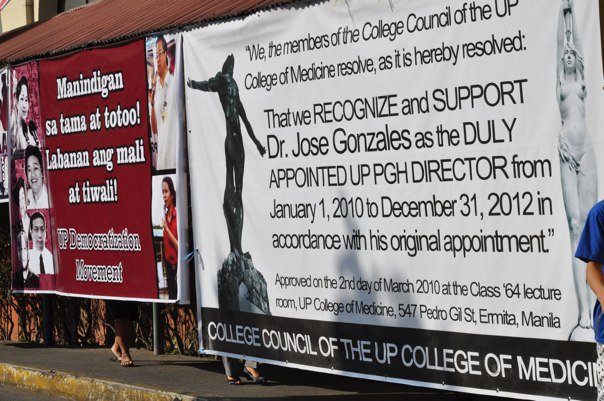
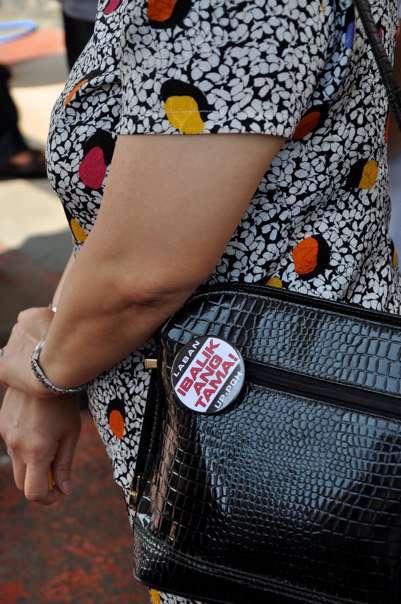
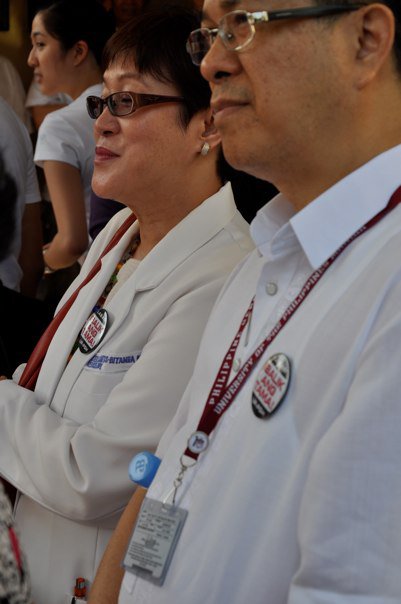
On Monday Morning, Flag Day, the U.P. PGH community says to U.P. President Emerlinda Roman: "We are more than just a small band of protesters."

By Chanda Shahani
Ignoring a ban against any mass assembly by the administration of the University of the Philippines (U.P.) Philippine General Hospital, hundreds of protesters made up of doctors, medical students, medical staff and members of the All-U.P. Workers Union converged today on the lobby of U.P. PGH today to lend support to the symbolic signing by PGH doctors of their intent to file mass leaves of absence (LOAs).
The LOAs by so many senior doctors are seen by many observers as a collective act of protest against the administration of U.P. President Emerlinda Roman, a professor of business administration at U.P. Diliman and who has very aggressively forced the issue of installing a less qualified Dr. Enrique Domingo as PGH Director over a more experienced and qualified Dr. Jose Gonzales through controversial corporate-style board room tactics at the Board of Regents that has angered students and faculty also in U.P. Diliman and U.P. Los Baños
102 doctors have so far signed and the setting up of a cordon as a symbol of the intent of the doctors and staff to continue with the protest until the U.P. Administration recognizess Dr. Jose Gonzales as the Director of PGH. However, LABAN UPPGH organizer, Dr. Iggy Agbayani has said in a Facebook update that the "mass LOA list formally ends ... at 102. Those who still wish to join are advised to sign the statement of support but not to file an official LOA at least while the others are on LOA. Somebody has to man the fort at PGH di ba."
Below are pictures of the symbolic mass LOA taken at U.P. PGH today by Dr. Iggy Agbayani:







Subscribe to:
Posts (Atom)