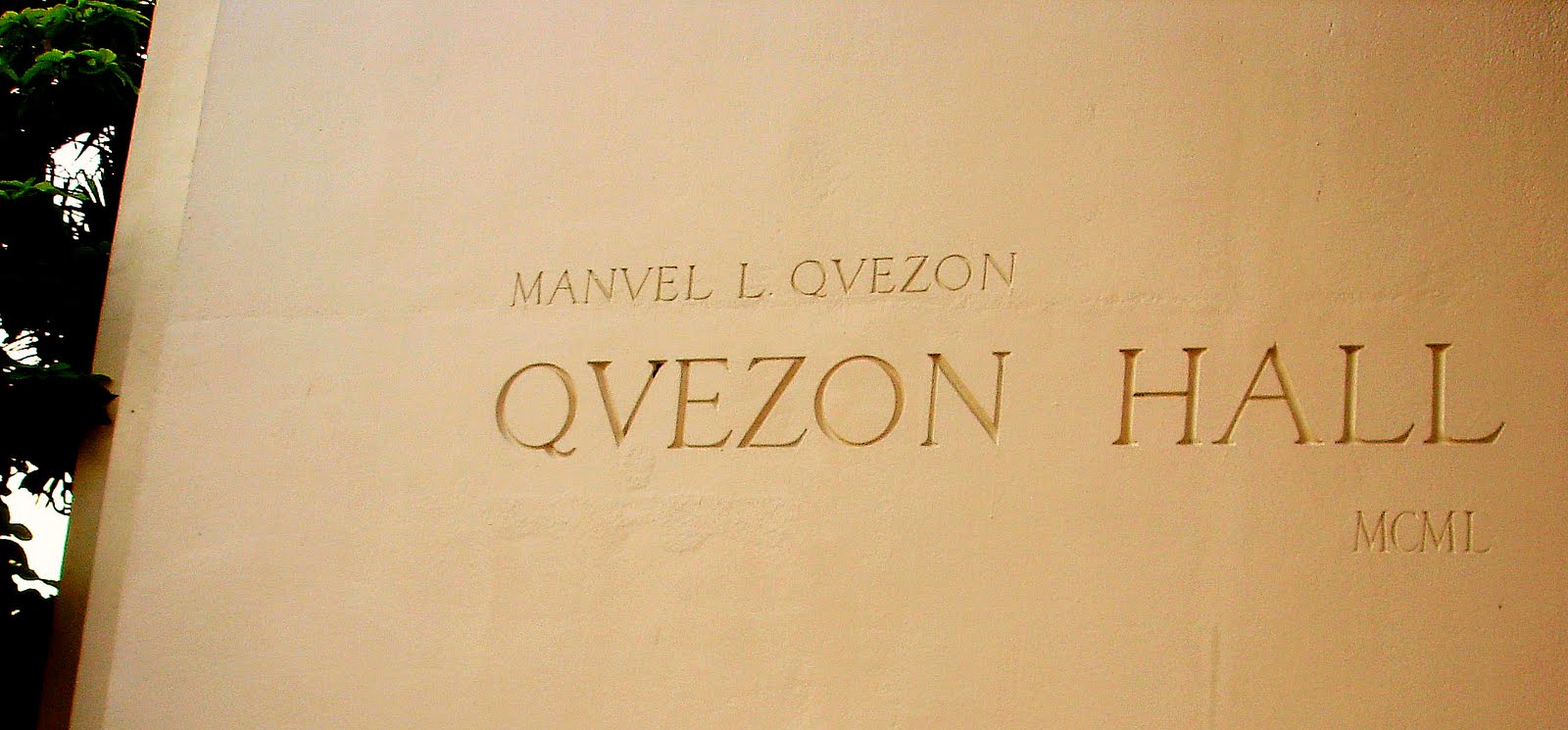
(Quezon Hall, U.P. Diliman where past U.P. presidents
have been selected by the BOR. Photo by: Chanda Shahani)
Once upon a time, a person was nominated as president of the University of the Philippines (U.P.) to the U.P. Board of Regents (BOR), but though the nominee did not have the support of U.P.'s famed but notorious “Wednesday Club,” that person proceeded anyway with the rigours of the search process, travelling throughout the U.P. System, defending, explaining and articulating that person's qualifications and vision before U.P.'s consitutents, hoping, in an unquestioned leap of faith, to convince the BOR to make an intelligent and principled choice for the best candidate. THE END.
This is the fate that awaits all those but the most consummate of insiders out of the total of eleven (11) nominees for the position of U.P. President, for despite the legal fiction that there is a “democratic” search process, the choice for U.P. President has all but already been determined in the inner halls of Quezon Hall, by a majority of the current BOR, for under the current configuration of the BOR, it is obvious to us in the Diliman Diary that only three types of candidates have been attracted to consent to being nominated as U.P. President: These are the members of the “Wednesday Club,” the decoys and the clueless.
The clueless
Our hearts go out for these particular nominees for U.P. President. By their life achievements, CVs, and vision statements, many of them are luminaries and worthy candidates in their own rights and could become good U.P. Presidents (See: http://diliman-diary.blogspot.com/2010/08/3_30.html and http://up.edu.ph/features.php?i=221). Yet with the current composition of the BOR, they have as much a chance in becoming U.P. President as an ice cube does of surviving beyond the first few milliseconds in Hell. These nominees are therefore nothing but warm bodies that the U.P. Administration is cynically manipulating to give credence to the argument that there will be credible competition for the U.P. Presidency, and this will not just be an inside job. It is quite unfair to lead these people on as these poor nominees have to shoulder their own airfare, hotel bills, food bills and travel throughout Luzon, Visayas and Mindanao to all the constituent universities within the U.P. System, not to mention sit in the proverbial hot seat everytime they have to argue their positions in front of a critical and discerning series of U.P. audiences. We also feel sorry for all their supporters who also have to make the requisite pilgrimages throughout the U.P. System. We also feel sorry for members of the audience who participate by attending the various presentations of the candidates, and even the members of the media who cover the "campaign." All of this will be for naught, as we will explain below.
The decoys
Alumni Regent Alfredo Pascual has accepted the nomination for U.P. President, but he also votes for the U.P. President as a BOR member. Although this is not prohibited by the rules per se, this is nevertheless problematic. We think that Regent Pascual will either withdraw his nomination later on; enhancing the impression that there was an ample number as opposed to a dearth of qualified candidates who had faith in the search process (see Diliman Diary, August 12, 2010: http://diliman-diary.blogspot.com/2010/08/dearth-of-nominees-for-up-presidency-is.html) or if he does not withdraw his nomination, Regent Pascual is essentially depriving the BOR of one vote by running, as if he really believed in himself then he will only vote for himself and not any one of the other ten candidates. However, assuming he invokes “delicadeza,” then he will not even vote for himself, resulting in an abstention. We urge a change of the rules in the future which would require a sitting regent to resign and nominate a replacement if he or she wishes to accept the nomination for U.P. President.
Meantime, former Department of Enlgish and Comparative Literature Professor Consolacion Alaras has just turned 69 on September 1, 2010 and there is a standing U.P. rule stating that no U.P. President can serve beyond the age of 70. Therefore, it is not likely that the BOR will select a candidate who can only serve for one year in a six-year term. Again, we make the point that our perception is that all of these are part of an internal arrangement to make it appear that there was once again a bumper crop of nominees for the U.P. Presidency in 2010.
Meantime, former Department of Enlgish and Comparative Literature Professor Consolacion Alaras has just turned 69 on September 1, 2010 and there is a standing U.P. rule stating that no U.P. President can serve beyond the age of 70. Therefore, it is not likely that the BOR will select a candidate who can only serve for one year in a six-year term. Again, we make the point that our perception is that all of these are part of an internal arrangement to make it appear that there was once again a bumper crop of nominees for the U.P. Presidency in 2010.
Presenting the winners: the members of the “Wednesday Club”
In fact, the process itself is fatally flawed as it allows consummate insiders such as as the expanded U.P. group known as the “Wednesday Club,” to stack the cards in their favour, and in effect perpetuate themselves in power by exerting a vise-like grip over the BOR which selects the next U.P. President. In our humble opinion, democratic “consultations” throughout the U.P. System are a mere show to preserve the legal fiction that there is indeed, a “process.”
The “Wednesday Club” is a loose agrupation of some CBA faculty and other U.P. officials who ostensibly meet for a round of drinks at the faculty lounge of the CBA every Wednesday evening, but is in reality a power-bloc made up of key officials who control the University of the Philippines System allied with key CBA Faculty such as President Roman, U.P. Diliman Chancellor Sergio S. Cao, former CBA Dean Erlinda S. Echanis and several others.
The “Wednesday Club” and the 2004 Search for a U.P. President
In fact, the most recent and glaring example of how flawed is this search process is the 2004 search for a U.P. President which resulted in the choice of Dr. Emerlinda R. Roman, a professor of business administration at U.P. Diliman as the U.P. President. Dr. Roman's track record as U.P. 's “Centennial President” has been mediocre at best, with some notable successes averaged out by an equally spectacular failures of policy and undemocratic governance (See Diliman Diary, June 6, 2010: http://tinyurl.com/2u4l4kj). President Roman succeeded in raising large amounts of money during the 2008 U.P. Centennial, was the driving force behind the construction of new infrastructure and buildings in the University, personally carried the ball for the passage of the 2008 U.P. Charter, and paved the way to upgrade the capability of the U.P. Faculty to bring the country into the new millenium. However, her term also saw the unilateral removal of former Student Regent Charisse Bañez from the BOR on a correctable technicality resulting in the ouster of Dr. Jose Gonzales as PGH Director; saw the privatization of portions of PGH by a financially unqualified firm utilizing a contract that the Department of Justice said was contrary to R.A. 9500 and saw her throw back the appeal of Professor Sarah Raymundo for tenure back to the Department from which the appeal originated from. The BOR later overturned Roman's decision. Roman also presided over the implementation of the large Class Policy Scheme on a pilot test basis in U.P. Los Baños in 2010 prior to its planned roll-out throughout the entire U.P. System. This scheme is being opposed by a significant chunk of UPLB Faculty and students though it is conceded that Roman enjoys the support of UPLB Chancellor Rey Velasco and his deans on this issue.
In fact, the dynamics of the voting show that even though there were four rounds of voting before the 2004 Malacañang regents closed ranks with the choice of then U.P. President Francisco Nemenzo, that is, then-U.P. Diliman Chancellor Emerlinda Roman, the odds were already stacked in Roman's favour by the expedient positioning of Roman allies within the BOR, thus torpedoing the ideal that every one of the eleven candidates had a fair and even chance of being considered for the U.P. Presidency (See: http://web.archive.org/web/20050205190656/up.edu.ph/roman_19th.htm). A breakdown of the composition of the BOR (http://tinyurl.com/2wouaz2) in 2004 (before the passage of the U.P. Charter of 2008, Malacanang had six regents in the BOR out of a total number of twelve voting regents) shows the following Roman allies positioned in place and in attack formation right before the round of voting began:
In fact, the dynamics of the voting show that even though there were four rounds of voting before the 2004 Malacañang regents closed ranks with the choice of then U.P. President Francisco Nemenzo, that is, then-U.P. Diliman Chancellor Emerlinda Roman, the odds were already stacked in Roman's favour by the expedient positioning of Roman allies within the BOR, thus torpedoing the ideal that every one of the eleven candidates had a fair and even chance of being considered for the U.P. Presidency (See: http://web.archive.org/web/20050205190656/up.edu.ph/roman_19th.htm). A breakdown of the composition of the BOR (http://tinyurl.com/2wouaz2) in 2004 (before the passage of the U.P. Charter of 2008, Malacanang had six regents in the BOR out of a total number of twelve voting regents) shows the following Roman allies positioned in place and in attack formation right before the round of voting began:
- President Francisco Nemenzo who declared that he would vote for Roman
- Alumni Regent and former General Jaime de los Santos, a former president of the U.P. MBA Alumni Society and a faculty member of the U.P. Diliman College of Business Administration (CBA).
- Faculty Regent Sergio S. Cao, a faculty member of the CBA.
- Rep. Cynthia S. Villar, Chair of the then House committee on Higher Education. Villar is a CBA graduate (1972), and her husband, Senator Manuel S. Villar (CBA, 1972) was a former president of the U.P. MBA Alumni Society
- Malacañang Regent Abraham Sarmiento, a known ally of President Nemenzo and then U.P. Diliman Chancellor Roman.
- Malacañang Regent Nelia Gonzales, a known ally of President Nemenzo and then U.P. Diliman Chancellor Roman.
- Student Regent Marco Dominic M. de los Reyes , who although he admitted voting for Roman in 2004, said he did so not out of political considerations, but on the principle that the issues in 2004 essentially boiled down to the BOR's having to choose between an acceptable U.P. insider such as Dr. Roman over former Ambassador Edgardo Espiritu, who was seen as an the personal choice of Gloria Macapagal-Arroyo, an unpopular president; and who embodied Malacañang interference in U.P.'s much-cherished academic freedom (Source: http://tinyurl.com/3y89m78).
It is quite clear that though the official vesion of events was that there were several rounds of split votes in the 2004 selection for the U.P. President in 2004 before Dr. Roman was finally chosen; in reality Dr. Roman already had the numbers from the very beginning, thus showing that equity very much belongs to the incumbent in the choice of a new U.P. President under 2004 rules. Given the fact that little has changed, however in 2010, except for the fact that Malacanang now has only the power to appoint three regents and there is now a Staff Regent, under the 2008 U.P. Charter (R.A. 9500), it is still the BOR alone that makes a decision, and whoever controls the majority of the BOR very much controls the dynamics of the outcome. It can be argued today that had there been less meddling by the “Wednesday Club” in the BOR, then individual BOR members, left to their own devices, would have given greater weight to the marketplace of ideas rather pure political considerations and chosen a more worthy candidate as U.P. President.
The Wednesday Club and the 2010 Search for a U.P. President
The Diliman Diary humbly submits to its readers that in view of the continued refusal of the three Malacañang Regents who were midnight appointees of former President Gloria M. Arroyo to step down despite the issuance by President Benigno S. Aquino III of Executive Order # 2, rescinding all midnight appointments, the hope that there will be a rational and principled majority decision on the part of the BOR to select a new U.P. President is not viable in view of the point that these three regents are no longer accountable to former President Arroyo for their decisions and by refusing to step down, are not giving President Aquino a free hand in choosing regents of his confidence.
Ironically, it is U.P. Diliman History Professor Ma. Serena Diokno, whom, along with U.P. Los Banos Chancellor Rey Velasco, and U.P. Diliman Chancellor Sergio Cao, whom we view as the three visible canidates of the “Wednesday Club.” The Diliman Diary bases its conclusions on the actions of the above three professors in recent important administrative cases in U.P. which were in direct support of the policies of the Roman administration.For example Dr. Diokno and Chancellor Cao had indirect and direct hands in opposing or denying U.P. Diliman Sociology Professor Sarah Raymundo's appeal for tenure while Chancellor Velasco's visible inaction in getting former Student Regent Charisse Bañez's enrollment papers updated (she was a UPLB student) on an easily correctable technicality so that her vote could be retained in favor of the choice of Dr. Gonzalez as Director of PGH is seen as an accommodation by observers to President Roman, who opposed Professor Raymundo's appeal and who did not vote for Dr. Gonzales. The willingness of these three to undertake these unpopular actions guarantees them prime spots in the "Wednesday Club," in our humble opinions.
Dr. Diokno has said that: “The rationale behind the public composition of the Board of Regents is precisely to make the University answerable to the public. If there is disenchantment with the make-up of the Board, the appropriate solution is to change its composition rather than do away with the accountability factor altogether” (http://www.up.edu.ph/oldforum/2004/Sept-Oct04/academic.html).
In fact, the three Malacanang regents who continue to attend BOR meetings and have refused to step down despite the issuance of E.O. # 2 are no longer accountable to any sitting President; however, judging by their voting records in the removal of Dr. Jose Gonzales as PGH Director earlier this year as well as the ouster of former Student Regent Charisse Banez, they are very the allies of outgoing U.P. President Emerlinda R. Roman. These three regents are Regents Abraham Sarmiento, Nelia Gonzales and Francis Chua.
The remedy, to use Dr. Diokno's logic, is for those who are disenchanted with the performance of these three regents is to to urge these three regents to resign, so that President Aquino may immediately replace them with persons of his trust and confidence. They must do this to eliminate the possibility that it is the tyranny of numbers in the BOR rather than an intelligent and reasoned analysis and perhaps discussion that should give each of the eleven candidates an equal chance of being considered for the top U.P. post. As Dr. Diokno has said “If collegiality is eventually expressed in terms of the majority vote, the assumption is that the vote was arrived at through open, reasoned discussion. It is the intelligent discussion that confers value upon the decision made by the majority and not the other way around as in a polity.” (Source: http://tinyurl.com/39fzbm8).
But more importantly, whether it is Dr. Diokno or Chancellor Velasco or even Chancellor Cao representing the “Wednesday Club” or even others who eventually are chosen as U.P. President, is the sheer necessity of having a credible process, in order for the next U.P. President to have the full but critical support of the U.P. community This cannot be accomplished, if the three overstaying Malacanang Regents who are midnight appointees refuse to step down despite the issuance by President Benigno S. Aquino III of Executive Order (E.O.) # 2, rescinding all midnight appointments of former President Gloria Macapagal-Arroyo by October 31, 2010. If they refuse to step down by the time voting takes place on November 17, 2010 for the U.P. Presidency they are depriving President Aquino of his constitutional right to appoint new individuals who are accountable to the Office of the President for their votes. Also, they are depriving U.P. of the best possible choice through independent and principled decision making instead of makibng a mediocre choice according to exisiting political alliances.
The irony is that it could be Dr. Diokno herself, seen as a card-carrying member of the “Wednesday Club,” who could be the one of the beneficiaries of the tyranny of numbers in the BOR with the three Malacanang regents and President Roman, acting as one power bloc, to constitute a vote of four and aligning themselves with at least one other power bloc to already choose the next U.P. President. For the benefit of our readers, here is one sample scenario of how the voting could go if the three Malacanang Regents refuse to step down by the time voting by the BOR starts on November 17, 2010:
1. BOR Chairpeson Patricia B. Licuanan – Does not vote unless there is a tie. But in an eleven-person BOR, and with the acceptance by Alumni Regent Alfredo Pascual (see below) of the nomination to run for U.P. President, Pascual is effectively removing not only his vote from the BOR, but also Chairperson Licuanan's, as the total number of remaining regents is nine, an odd number, and making it impossible for there to be tie, unless another regent is sick or absent on the day of voting.
2. BOR Co-Chairman U.P. President Emerlinda R. Roman – Will vote for a “Wednesday Club member.”
3. Member Sen. Edgardo J. Angara. Chairman, Senate Committee on Education, Arts, and Culture
As a former U.P. President, Sen. Angara has impeccable ties with former U.P. President Nemenzo
and President Roman and is expected to vote for a “Wednesday Club” member.
4. Member Rep. Juan Edgardo M. Angara. Chairman, House Committee on Higher Education
Rep. Angara is expected to follow the lead of his father, Sen. Angara, thus adding one more vote
for a “Wednesday Club” member.
5. Member Alfredo E. Pascual. President, UP Alumni Association. By running for U.P. President, Regent Pascual deprives the alumni of representation in the BOR as he will not vote for any other candidate except himself and it is extremely probable that he will abstain from voting.
6. Member Judy M. Taguiwalo, Faculty Regent. Will vote independently for the best candidates as per her personal, professional and ethical criteria
7. Member Cori Alessa C. Co, Student Regent. Will vote independently for the best candidates as per her personal, professional and ethical criteria
8. Member Hon. Clodualdo E. Cabrera, Staff Regent. Will vote independently for the best candidates as per her personal, professional and ethical criteria
9. Member Former Justice Abraham F. Sarmiento
Midnight appointee of former President Gloria Macapagal-Arroyo. Justice Sarmiento was appointed as a midnight appointee, but good only until September 29, 2010 (http://diliman-diary.blogspot.com/2010/03/success-diliman-diary-finally-gets.html) However, unlessthe Roman-dominated BOR itself nominates a replacement or renominates Justice Sarmiento, he is likely to serve in a holdover or acting capacity allowing him to vote for a member of the Wednesday Club . Assuming that he is replaced on October 31 or afterwards as per E.O. # 2, he and the U.P. legal Office may challenge this in court and successfully resort to legal dilatory tactics until at least November 17, 2010, which is quite feasible, considering that the U.p. Legal office is stuffed with U.P. College of Law professors. Justice Sarmiento can theefore cast his much coveted vote for a member of the “Wednesday Club.”
10 Member Francis C. Chua
Midnight appointee of former President Gloria Macapagal-Arroyo. Even if he is removed by E.O. # 2, he remains in a holdover or acting capacity until the BOR nominates a replacement. But all the Roman-dominated BOR has to do is to nominate a replacement after November 17, thus allowing Regent Chua to give his nod to a member of the “Wednesday Club.”
11. Member Nelia Gonzalez
Midnight appointee of former President Gloria Macapagal-Arroyo. Even if she is removed by E.O. # 2, hse remains in a holdover or acting capacity until the BOR nominates a replacement. But all the Roman-dominated BOR has to do is to nominate a replacement after November 17, thus allowing Regent Gonzalez to give his nod to a member of the “Wednesday Club.”
So, here's the projected play: President Roman and the three Malacañang regents coalesce to form a voting bloc that will vote for one of the “Wednesday Club” members. Senator Angara and Congressman Angara will probably close ranks with them. This could take one, two or even more rounds but they will consistently choose a member of the “Wednesday Club.” However, only one surviving “Wednesday Club” member will be chosen in the final round. Total number of votes = 6 out of 11 votes.
The three sectoral regents – that is Faculty Regent Judy Taguiwalo, Student Regent Cori Allessa Co and Staff Regent Clodualdo "Buboy" Cabrera will choose candidates that suit their ethical, professional and politcal beliefs. Total number of votes = 3 votes out of 11 votes.
Chairperson Patricia Licuanan and Alumni Regent Alfredo Reyes will not participate in the voting for the reasons described above. Total number of abstentions = 2 votes.
So there you have it, the next U.P. President remains very much the personal choice of President Roman. Since the U.P. Administration wants to convey the impression that the choice for the next U.P. President will be done “democratically” through “open consultation,” and that it will be a hard-won and closely fought contest by a short-list of worthy candidates, it is likely that the three “Wednesday Club members,” that is Chancellor Cao, Dr. Diokno and Chancellor Velasco will survive the first round of eliminations and go into a second or even more rounds. Yet, there can only be one surviving choice. Who will it be?
The bottom-line: The Roman Administration must stop its intervention in the BOR if we are to get the best possible nominee for U.P. President chosen by the BOR.

(Has the torch already been passed even before we
have begun? We hope not. We are hoping for spirited
and principled debates within the BOR that will ensure
the best possible choice for the position of U.P.
President. Photo: http://www.up.edu.ph/)
have begun? We hope not. We are hoping for spirited
and principled debates within the BOR that will ensure
the best possible choice for the position of U.P.
President. Photo: http://www.up.edu.ph/)
But U.P. deserves the best possible candidate over and above this “Wednesday Club” triumvirate, chosen after thorough and intelligent discussion in the marketplace of ideas by the BOR. This is the reason why the candidates also subject themselves to the process of consultation so as to provide the BOR with a valuable feedback mechanism in order to guide them individually in their decision making. At the end of the day, however, the Diliman Diary urges the Roman Adminstration's allies in the BOR – that is the three Malacañang Regents to do the heroic thing by taking the initiative and resign before the voting for a new U.P. President takes place on November 17; because they no longer represent the current President of the Philippines whom they are supposed to be accountable to. They may opt to wait until E.O. # 2 takes effect on October 31, but there is every chance that they can continue to vote in an acting capacity until President Aquinio appoints new regents. However, with approximately 3,000 midnight appointment cases on its plate, the probability is extremely high that we will have a new U.P. President, voted in part by the holdover Malacanang regents, long before President Aquino appoints their replacements.
In this regard, the Diliman Diary calls upon Alumni Regent Alfredo Pascual to resign as president of the U.P. Alumni Association (the president of the U.P. Alumni Association automatically becomes the Alumni Regent under R.A. 9500) so that he may step down as Alumni Regent; and to set into place the UPAA's mechanism for letting the second-in-command of the UPAA take over his post, as UPAA President and Alumni Regent. This would be acting in the spirit of “delicadeza,” if he wishes to run for the position of U.P. President, and in fact he already possesses an undue advantage because he is privy to the innermost deliberations of the BOR on the issue of what they want to see in a U.P. President and moreover, he even has access to al the BOR members in a way that the other candidates do not. Unless he resigns, he is depriving the BOR of an independent vote that will objectively consider all candidates with an open mind. Alternatively, Regent Pascual should withdraw his nomination for the position of U.P. President, if he wishes to participate in the selection of the U.P. President in the BOR so that the alumni will have the assurance that their primary representative is casting his vote for the best posible person as he sees fit.
If these four regents do not undertake timely action for the good of the University they claim to serve, we could end up with yet another mediocre U.P. President chosen by a very exclusive club made up of a dwindling membership with the vast majority of U.P.'s constituents alienated from the decision making process. Despite all the trappings of “democratic governance,” and “consultation,” therefore in the search for a new U.P. President, it will be the same group of interlocking interests exercising its particularly virulent form of undemocratic governance which will hinder rather than help U.P. regain its premier standing as the top university in the nation.
We also call upon President Roman to do the heroic thing by not intervening in the composition of the BOR, even though the temptation to do so may be very great indeed. President Roman, you had your chance to serve U.P. ; you diligently carried out your mandate and your ten-point plan (although some will disagree with the plan itself or how it was carried out, yours truly included) and you worked hard as U.P. President. Correction: Very hard. Now please let others beyond the members of the "Wednesday Club" have an equal chance of being considered but once selected, let's give the new U.P. President a chance to make his or her mark and support that person. All power is, after all, temporary and it is in the gracious letting go of it, once it has been judiciously exercised that also confers honor and dignity to its wielder.
(Chanda Shahani is the Editor of the Diliman Diary)

