A frenzy of real estate deals by the U.P. Board of Regents (BOR) dominated the proceedings of Outgoing U.P. President Emerlinda R. Roman's last meeting at the BOR on January 27.
According to the Facebook page of Student Regent Jaque Eroles, the BOR approved the following real estate deals: The LoveNature! Park in UPV-Miagao, the Solar Power Plant Project in UPLB, and the AyalaLand lease in UPIS land were all approved today at Roman's last BOR meeting.
The Diliman Diary will be updating this dispatch as more details become available.
Showing posts with label BOR. Show all posts
Showing posts with label BOR. Show all posts
Thursday, January 27, 2011


Saturday, October 30, 2010
U.P. Faculty Regent’s Updates on the October 28 Board of Regents’ Meeting
By Faculty Regent Judy M. Taguiwalo
Faculty Regent’s Updates on the October 28 Board of Regents’ Meeting
October 29, 2010
The regular monthly meeting of the BOR was held last October 28 at Quezon Hall, UP Diliman. Only seven of the 11 board members were present: President Emerlinda Roman, Rep. Juan Edgardo Angara, Alumni Regent Gladys Tiongco, Regent Nelia Gonzales, Student Regent Cori Alessa Co, Staff Regent Buboy Cabrera and I. Chair Licuanan and Senator Angara were out of the country on official business. Regent Chua was not present and Malacanang has not named a new Regent in place of Regent Sarmiento who passed away last October 3 in Prague, Czech Republic, where he was visiting his daughter, the current Philippine Ambassador to that country.
Here is my update on significant items of the meeting. Staff Regent Buboy Cabrera said he will make the report on the discussion of the Sagad award and the additional 10 days sick leave benefits for REPS and administrative staff.
1. Search for the next UP President: The November 19 BOR meeting to select the new UP President was reiterated. The interview by the Board of the 11 nominees will be held the day before or on November 18.
2. Faculty Regent Selection process: Vice President for Academic Affairs Amelia Guevara reported to the Board the results of the first round of nomination for the Faculty Regent Selection. The 2011-2012 Faculty Regent will come from UP Los Banos. The top five nominees and their votes during the first round are the following:
Teodoro Mendoza --- 428
Ida Dalmacio ----------- 159
Salvador Catelo ------- 100
Jezie Acorda ------------ 35
Felino Lansigan and Rita Laude ---30
The breakdown per CU of the first round of nomination showed that Dr. Mendoza topped the nomination in all six constituent universities except at the OU where he got one out of four votes.
The names of those going into the second round of nominations (meaning those who accepted the nominations) will be known by the first week of November. The actual voting which will select the next Faculty Regent will be on November 15 to 18, 2010 on the dates specified by the administration of the various CUs.
The rules for this selection prohibit campaigning by the nominees. Deans may however invite the nominees to talk to the faculty if they so desire. It is therefore important for us to read the CVs and vision statements of the nominees once they are uploaded on the UP website for us to make an informed choice of our next representative to the Board of Regents.
1. UP Budget: The P1.39 billion budget cut for the 2011 UP budget remains as of second reading in the HOR. Rep. Angara requested President Roman to submit priority items that may be included when the House committee deliberates on possible insertions to the budget. President Roman said she will do so and emphasized the need for additional MOOE for PGH whose budget has been cut. The budget deliberations will continue once Congress resumes sessions on November 8.
1. Appointments of officials:
Dean, School of Library and Information Studies (SLIS), UPD—Prof. Johann Frederick A. Cabbab
Dean, College of Social Work and Community Development, UPD—Dr. Rosalinda Pineda-Ofreneo
Director, National Institute of Molecular Biology and Biotechnology, UPD—Dr. Cynthia T. Hedreyda (third term)
5. COA report on the UP Mindanao Chancellor: As I shared with you in my September update on BOR meeting, the concern raised regarding the overspending in the 2007 investiture of the UP Mindanao chancellor was tabled for the next meeting. The Commission on Audit in Davao City in its August 23, 2010 “Report on the Special Audit /Investigation Conducted of the University of the Philippines Mindanao “ found that that Chancellor Rivero had overspent by P269,584.67 or by 72% of the approved budget investiture budget of P374,216. The report ended with the recommendation that the UP Mindanao Chancellor should “ be admonished to prioritize the allocation of its funds on U.P.-Min's mandated purposes.” (For a copy of the August 2010 COA report, please see http://diliman-diary.blogspot.com/2010/09/commission-on-audit-criticizes-up.html). The Presidents of the UP Mindanao chapters of the All UP Workers Union and the All UP Academic Employees Union as well as the Chair of the UP Mindanao Student Council wrote “strongly urging” the Board to:
“Let Dr. Rivero personally restitute the excess amount spend during her investiture, amounting to PhP269,584.67. It is clear from the breakdown of this amount that the expenses were extravagant, unnecessary, or personal (i.e., expenses of her guests); Recall Dr. Rivero’s appointment as chancellor of UP Mindanao based on moral integrity and misuse of limited funds; to whom much is given, much is expected in terms of accountability;
Translate “admonish” into specific sanction for Chancellor Rivero.“
President Roman said that Chancellor Rivero had appealed the decision of the COA and the COA Mindanao report has not been officially transmitted to the University. The Board should recognize the right of the Chancellor to due process before taking any action.
1. Implementation of the May 27,2010 BOR decision granting the appeal for tenure of Prof. Sarah Raymundo: Sarah Raymundo remains without any teaching appointment over five months since the BOR decision. The Department of Sociology continues to refuse to prepare her appointment papers. Other options for Sarah Raymundo have been explored but none has led to any possibility that she will be able to teach this second semester.
2. Tenure issue of UP Cebu Professor Roberto Basadre : Prof. Basadre has fulfilled all the requirements for tenure and has been recommended by the UPV Cebu College Academic Personnel Committee for tenure last September 4, 2009. The Dean of the UPV Cebu College overruled the recommendation for tenure on the grounds of the possible reorganization of UP Cebu High School. Instead the waiver rule (extending the temporary appointment of a faculty, usually used to allow time for faculty members’ publication to come out) was used to extend his temporary appointment twice in a row. With the creation of UP Cebu College as an autonomous unit under the Office of the President, the tenure recommendation of the CAPC remains unacted and Prof. Basadre is in danger of losing his teaching assignment when his temporary appointment ends in May 31, 2011. In fact the UP Cebu College Dean wrote that :
I again raised the issue in the October 28 BOR meeting and observed that the creation of UP Cebu College would have as its victim Prof. Basadre. President Roman said she will clarify this with Dean Avila of UP Cebu College.
Other items deferred for future deliberations:
1. The UP Administration recommended that the “computation of the sick leave benefits of those faculty extended beyond age 65 be based on the salary of actual retirement date instead of the salary at age 65.” The Staff Regent asked for a deferment of approval so that information on the possibility of extending this to administrative staff and REPS could be explored. I also asked for deferment until the information on the names and number of faculty who would benefit from this policy and the financial implication of such extension be provided to the Board. My request for deferment is also based on the fact that the UP Administration has objected (on account of lack of money) to extending to faculty members who have reached the ceiling of their ranks as Assistant Professor or Associate Professor to cross ranks outside of the regular call for promotion. This policy of crossing ranks outside of the call for promotion currently applies only to faculty members who are about to retire.
2. Professor Emeritus: I was provided a copy of the September 24 letter to the UP System Committee on Professor Emeritus written by seven professors of the Land and Water Resources Division of the Institute of Agricultural Engineering regarding the nomination of Dr. Wilfredo David, former UPLB Chancellor, as Professor Emeritus in Agricultural Engineering. That letter also pointed out that the college recommendation “to extend the services of Dr. David for one year beyond the mandatory retirement age of 65 years was not favorably acted upon by the present UPLB administration.”
On October 20, I requested to have this item on the agenda of the BOR meeting. Prior to the October 28 BOR meeting, the OSU provided me a copy of the October 21 letter of Vice President Guevara, who heads the system committee on professor emeritus , to the UPLB professors. In that letter, VP Guevara explained that the “UP System committee evaluates only the nominations endorsed by the Chancellors, upon the recommendation of their respective CU committees on Professor Emeritus”. In the same letter, VP Guevara informed the professors that “Dr. Wilfredo P. David was not nominated by UPLB Chancellor Rey Velasco. In his letter, Chancellor Velasco informed our office that “Four faculty retirees with the rank of full professors were evaluated by the UPLB Committee on Professor Emeritus but the Committee believes that none of them qualifies to be nominated to the prestigious nomination.”
During the BOR meeting, VP Guevara further explained that the Dean of the College to which Dr. David used to be connected did not recommend him for Professor Emeritus. I said that there are several concerns emerging from this issue:
- The need for transparency on the criteria for selection of professor emeritus and the composition of the committee tasked to make the recommendations; (I have been provided a copy of the criteria used by UP Diliman for the professor emeritus nomination but none from UPLB)
- The need to inform faculty members nominated for professor emeritus but who were not awarded the title the reason for such decision. Those nominated for professor emeritus belong to a small group of distinguished professors of the university and they at least deserve to be informed of the reason why they have not been awarded the title.
Monday, April 5, 2010
On Monday Morning, Flag Day, the U.P. PGH community says to U.P. President Emerlinda Roman: "We are more than just a small band of protesters."

By Chanda Shahani
Ignoring a ban against any mass assembly by the administration of the University of the Philippines (U.P.) Philippine General Hospital, hundreds of protesters made up of doctors, medical students, medical staff and members of the All-U.P. Workers Union converged today on the lobby of U.P. PGH today to lend support to the symbolic signing by PGH doctors of their intent to file mass leaves of absence (LOAs).
The LOAs by so many senior doctors are seen by many observers as a collective act of protest against the administration of U.P. President Emerlinda Roman, a professor of business administration at U.P. Diliman and who has very aggressively forced the issue of installing a less qualified Dr. Enrique Domingo as PGH Director over a more experienced and qualified Dr. Jose Gonzales through controversial corporate-style board room tactics at the Board of Regents that has angered students and faculty also in U.P. Diliman and U.P. Los Baños
102 doctors have so far signed and the setting up of a cordon as a symbol of the intent of the doctors and staff to continue with the protest until the U.P. Administration recognizess Dr. Jose Gonzales as the Director of PGH. However, LABAN UPPGH organizer, Dr. Iggy Agbayani has said in a Facebook update that the "mass LOA list formally ends ... at 102. Those who still wish to join are advised to sign the statement of support but not to file an official LOA at least while the others are on LOA. Somebody has to man the fort at PGH di ba."
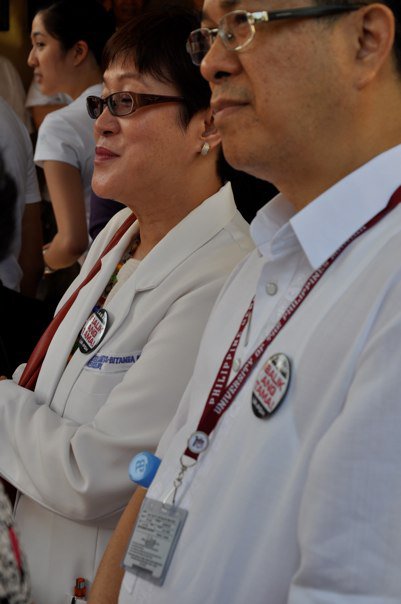
Below are pictures of the symbolic mass LOA taken at U.P. PGH today by Dr. Iggy Agbayani:








Sunday, March 28, 2010
U.P. PGH Crisis Deepens with resignation of Associate Dean of the U.P. College of Medicine and Planned Mass LOA of UPCM Faculty over the issue of Academic Freedom

The Associate Dean for Planning and Research of the University of the Philippines College of Medicine (UPCM), Dr. Abundio A. Balgos, has resigned.
The resignation, which took effect last March 23, 2010 was done “in protest of the death of academic freedom and BOR tyranny. President Roman and her BOR cronies hav been downplaying d U.P. Manila PGH protests re student regent and PGH Director (Jose) Gonzales ... After my resignation as UPCM associate dean to protest the death of academic freedom and BOR tyranny, 50 more UPCM faculty are sumbitting mass leave of absence on Monday (March 29, 2010) during the PGH flag ceremony protest rally to b joined by fac(ulty), students and all U.P. Workers Union,” Dr. Balgos said in a message posted in the website, U.P. Issues (http://upissues.wordpress.com//).
The UPCM Faculty are protesting the decision by the U.P. Board of Regents (BOR) to disregard their academic freedom as faculty which they formally expressed in a resolution of the College Council last March 2, 2010. In that resolution they said that the appointment of Dr. Jose C. Gonzales as Director of the Philippine General Hospital from January 1, 2010 to December 31, 2012 should be respected by the very same BOR that selected him on December 18, 2009 and then removed him on February 25, 2010.
The Diliman Diary has extensively covered the intricate politics and the background behind the arbitrary removal of Dr. Gonzales by the BOR (please see Diliman Diary, March 22, 2010 (http://diliman-diary.blogspot.com/2010/03/alternative-copy1.html). The issue at hand that is being strongly emphasized by the UPCM Faculty, however is that the BOR, which is currently dominated by allies of U.P. President Emerlinda Roman should respect the academic freedom of the majority of the UPCM Faculty to determine that Dr. Gonzales, who is regarded as being more senior and experienced than his replacement, Dr. Enrique Domingo, complete his term of office.
Is President Roman contradicting President Roman?
For President Roman, the essential contradiction is that by tolerating the use of legal manuevers by U.P.'s legal department to justify the removal of Dr. Gonzales by the BOR, she is essentially riding roughshod over the UPCM faculty's much-cherished academic freedom to employ its collective judgement and expertise in determining that Dr. Gonzales should serve out his full term as PGH Director because of his performance and qualifications.
The resignation of Dr. Balgos as Associate Dean, and the planned mass leave of absence by such a large number of UPCM Faculty is seen by observers as a combined vote of confidence for Dr. Gonzales, and a vote of no-confidence in the BOR's decision to replace Dr. Gonzales with Dr. Domingo.
President Roman has said in the past that the BOR should not get involved in matters involving the academic freedom and expertise of a particular subset of faculty belonging to a particular discipline. For example, in a December 18, 2009 letter she wrote to U.P. Diliman Sociology Professor Sarah Raymundo denying her appeal to overturn the decision of U.P. Diliman Chancellor Sergio Cao denying her tenure, Roman said that:
“Our tradition in the university of upholding and maintaining sacrosanct departmental autonomy do not allow us – rightly – to make a decision simply on the basis of the number of people supporting a particular proposition.”
“Upholding the autonomy of the Department of Sociology in its determination that Professor Raymundo should not be granted tenure is vital to maintaining the institutional autonomy guaranted under the U.P. Charter. This is also what the Department and the CEB (College Executive Board) have been insisting throughout the entire process."
"The implication of asking the President and the Board of Regents, at every turn, to substitute their judgement for that of members of the faculty of a department, unit, college or university is fraught with danger as it may transform a purely academic function into a political exercise.” (http://tenureforsarahraymundo.blogspot.com/)
Other points in the UPCM College Council resolution
Other points in the UPCM College Council resolution commenting further about Dr. Gonzales said that:
- He had already taken his oath of office as Director of Philippine General Hospital, University of the Philippines Manila before the BOR Chair on December 21, 2009 and before the UP Manila Chancellor on January 7, 2010;
- Served as PGH director and has performed responsibly since January 4, 2010 with honor , integrity and transparency;
- Under Civil Service Laws, Dr. Jose Gonzales can only be removed as PGH Director for due cause;
- His removal as PGH Director is unjust and arbitrary, he should therefore continue to perform his duties and functions as Director of PGH.
But no matter how vocal protests become against the decision to remove Dr. Gonzales, the Diliman Diary has concluded that the U.P. System still holds one trump card over the UPCM Faculty - the U.P. System's institutional academic freedom outweighs Dr. Gonzales' legal complaint against being unjustly removed - or at least that's how the courts see it.
The Diliman Diary's legal consultant, Atty. Noel C. Ducusin has analyzed the issue of how academic freedom always benefits the institution over the individual litigant in a court of law, no matter what the circumstances are. This means that a case in courts regarding Dr. Gonzales' tenure may have difficulty in succeeding if the U.P. Administration invokes its institutional academic freedom. In court cases, judges routinely defer to the U.P. Board of Regents' presumed expertise in academic matters. The U.S. case of the Garcia v. Faculty Admissions Committee which has been extensively referred to in Philippine jurisprudence, summarizes this reflexive bias in this manner:
"There is, as previously noted, the recognition in the Constitution of institutions of higher learning enjoying academic freedom ... Justice Frankfurter, with his extensive background in legal education as a former Professor of the Harvard Law school, referred to what he called the business of a university and the four essential freedoms in the following language: "It is the business of a university to provide that atmosphere which is most conducive to speculation, experiment and creation. It is an atmosphere in which there prevail "the four essential freedoms" of a university - to determine for itself on academic grounds who may teach, what may be taught, how it shall be taught, and who may be admitted to study." (Garcia v. Faculty Admissions Committee, 68 SCRA 277, G.R. No. L-407779, November 28, 1975).
The irony here is that because it is Dr. Gonzales who has filed an individual suit - and not the majority of UPCM faculty who have filed a class action suit - then the U.P. BOR has the luxury of preempting the UPCM's academic freedom argument by invoking its own institutional academic freedom in its defense against charges of unjust treatment of Dr. Gonzales. The U.P. Administration can easily say that it has the necessary expertise to determine who may teach , assuming for the sake of discussion that PGH is not just a hospital but is also a learning environment for UPCM students and that the court should defer to its institutional expertise on the matter. Based on Attorney Ducusin's extensive study of Philippine jurisprudence, the courts will, in all probability, defer to the academic institution's arguments.
Wednesday, March 3, 2010
Undemocratic Governance by the University of the Philippines System Leadership is Lambasted by Faculty, Staff, and Students at U.P. Diliman Press Briefing

U.P. Faculty, Staff and Students giving their
thumbs down to the incumbent U.P. Administration
thumbs down to the incumbent U.P. Administration
By Chanda Shahani
From the joyous year-long 2008 University of the Philippines (U.P.) Centennial Celebrations peaking with the passage into law of the U.P. Charter of 2008 (R.A. 9500). To this. Perhaps U.P. President Emerlinda R. Roman should start popping a series of Extra-Strength Tylenol tabs as prophylaxis for a projected series of headaches; as a growing number of U.P. System Faculty, Students and Staff are becoming increasingly vocal about what they call her leadership's lack of democratic governance consequently creating a host of long-term problems for the premier state university and its constituents.
A press briefing was held on March 3, 2010 at the 3rd floor of the College of Social Work and Community Development (CSWCD) at U.P. Diliman to represent a coalition of groups including the Faculty Regent Judy Taguiwalo, Student Regent Charisse Bañez, Staff Regent Buboy Cabrera, Dr. Jose Gonzales of the PGH, several PGH doctors, concerned University of the Philippines (UP) faculty and students, and the All U.P. Workers Union. They have all been united by converging interests centering on the following key issues involving decisions involving the U.P. System Administration which they are questioning.
Some of the key highlights of the briefing include:
- For the first time in UP’s history, students were stripped of their representation from the UP Board of Regents (BOR) as the current student regent was prevented from attending the board meeting and removed from her position due a technicality.
- For the first time in UP’s history, three regents overstayed their temporary designations to the BOR which lapsed in 2009.
- For the first time in UP’s history, the appointment of a University official was revoked without due cause. In UP Manila, the sitting PGH director, Dr. Jose Gonzales, was removed from his post a month after he was appointed by the board and sworn in as director.
- For the first time in UP’s history, classes as large as 300 will be the norm at UP Los Baños, leading to a degradation in each student's quality of education.

She commented that copies in the press kit of several students' Form-5s which are U.P. students' proof of enrollment showed conclusively that unlike Student Regent Bañez, other students at U.P. Los Baños were allowed to enroll late beyond the claimed absolute and non-negotiable deadline of November 17, 2009 of the U.P. Administration for all UPLB students. One student enrolled for residency on February 2, 2010 and the other enrolled on February 16, 2010. Thus the unwillingness of the UPLB administration was due to pressure from the U.P. Administration which was not to give the Student Regent equal treatment as other UPLB students which was in turn was directly linked to her independent stand on the issue of who should be U.P. PGH Executive Director.
During the press briefing, Student Regent Bañez was even more emphatic in characterizing the linkage between her attempted ouster as Student Regent and Dr. Gonzales as Executive Director of U.P. PGH: "Malacañang at Roman itaksil sa Pamantasan. Education not for sale. U.P. not for sale," she said.
In a March 1, 2010 report also released during the media briefing, Faculty Regent Judy M. Taguiwalo said that she raised the issue during the February 25, 2010 BOR meeting, of the legitimacy of the three Malacañang appointed regents, Abraham Sarmiento, Nelia Gonzales and Francis Chua. She said that all three were appointed as "acting" regents on September 2008, March 2008 and January 2008 respectively by Philippine President Gloria Macapagal-Arroyo.
Faculty Regent Taguiwalo cited the Administrative Code of 1987 (E.O. 292) which said that the President of the Philippines has the power to "issue temporary designations" but "(i)n no case shall a temporary designation exceed one (1) year."
She said that Vice President for Legal Affairs Atty. Theodore Te said during the February 25 BOR meeting that this issue could not be tackled by the BOR because the status of the three is included in a court case filed b y the Student Regent in the Quezon City Regional Trial Court and any discussion would be considred sub judice and that "temporary designation" is different from an acting appointment based on Supreme Court rulings. Taguiwalo said she consulted a lawyer afterwards, who showed her an excerpt from a Supreme Court ruling, Pimentel vs. Ermita (GR 164978 13 October 2005) which expressly ruled that "Acting appointments cannot exceed one year as expressly provided ... (in) EO 292."

Regent Taguiwalo said that she put her objection on record to the participation of the three Regents on the grounds that their appointments have already expired. The U.P. Administration is claiming that a unanimous vote of the BOR on February 25 resulted in the removal of Dr. Gonzales and the approval of a draft resolution voiding the legitimacy of Student Regent Bañez's right to vote from December 18, 2009 onwards on the grounds that she is no longer a student and therefore no longer a Student Regent. That may be an exaggeration. Nine regents attended the February 25 BOR meeting but three regents - Staff Regent Cabrera, Faculty Regent Taguiwalo and Alumni Regent Pascual abstained from voting leaving six regents who particpated in the voting. However three regents had expired appointments at the time of the voting, meaning that only three regents voted on February 25 which does not constitute a majority of the BOR.
"Parang sampal sa mga doctors ng PGH ang ginawa nila," said Dr. Jonas del Rosario, an Assistant Professor of the Department of Surgery at the U.P. College of Medicine who spoke during the press conference. He was referring to the ouster of Dr. Jose Gonzales by the BOR last January 29, 2010 or about a month after he won in the voting by the BOR for the selection of a new Executive Director last December 18, 2009. "They are not respecting the civil service law," he said.
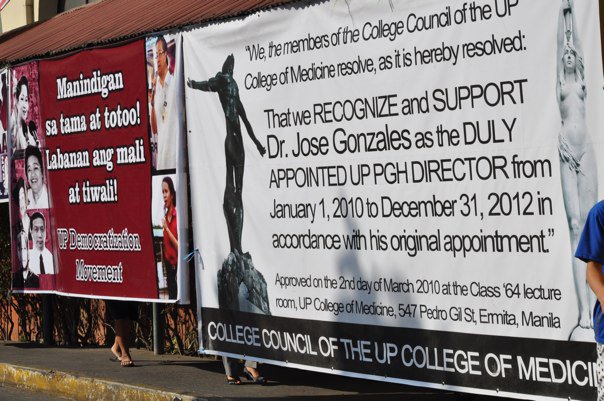
A March 2, 2010 resolution of the College Council of the U.P. College of Medicine also threw its support behind Dr. Gonzales. A resolution of any College Council in the U.P. System is considered especially important, by U.P. standards, in view of U.P.'s historic commitment to the principles of college and departmental autonomy. The resolution said that "Dr. Gonzales has already served as PGH director and has performed responsibly since January 4, 2010 with honor, integrity and transparency."
The resolution said the College Council resolved to "recognize and support Dr. Jose Gonzales as the duly appointed UP PGH director from January 1, 2010 to December 31, 2012 in accordance with his original appointment."
A statement dated March 3, 2010 and released by CONTEND during the press briefing criticized President Roman for her "unrelenting effort to transform the University into a private commercial educational institution." One example is the proposal for large class sizes of 150 to 200 in general education courses starting in UPLB which "considerably lowers the expectations for quality while blatantly hewing to the logic of mass marketing."
The CONTEND statement openly criticized President Roman, a faculty member of the U.P. College of Business Administration in Diliman with a Ph.d. in Business Administration from the same college, for "her unrelenting effort to transform the University into a private commercial educational institution ... Her philistine imposition of the narrow parameters of profitability for measuring or evaluating academic excellence in the University is simply unacceptable for any institution dedicated to teaching, learning and the deepening of knowledge. Her desire to transform the University into a privatized educational corporation is incompatible with the ideals of the University to serve the people and provide education for the poorest and least privileged in Philippine society."

- On the complaint of Student Regent Bañez for a temporary restraining order where she said the votes cast in the January 29 BOR meeting to remove her eligibility to vote as Student Regent starting December 18, 2009 were invalid in the January 29 BOR meeting because there was no quorum: "The minutes of the January meeting of the Board were approved by the Board in its February meeting. Nobody questioned the quorum precisely because there was a quorum. Ms. Bañez was wrong when she said there was no quorum," Roman said.
- On the issue of the report of Faculty Regent Judy Taguiwalo where she raised an issue regarding the legitimacy of the three Malacañang-appointed regents since they have expired terms. Roman said that, "The terms of the three regents appointed by Malacañang are the subject of a court case filed by the Student Regent. This case is before the court now. Therefore I shall not be able to comment on this. Suffice it to say that our arguments regarding their tenure have been firmed up and U.P.'s lawyer will present these to court."
- On the issue of Faculty Regent Judy Taguiwalo objecting to Regent Nelia Gonzales' motion to appoint another PGH Director other than Dr. Gonzales, since the board cannot remove an official who has taken his oath of office except for cause, Roman said that: "The rule they are citing does not apply in the case of Dr. Jose Gonzales. His appointment has been voided by the Board because Ms. Bañez was not qualified to vote by virtue of her not being a student at the time of the election. If Ms. Bañez' vote is not counted, Dr. Gonzales would have lost in the vote. Hence the need to elect another director."
- On the issue of the Faculty Regent Judy Taguiwalo being unable to understand why the Chancellor of U.P. Los Baños continues to deny Bañez’s appeal for late filing of residency as it had been granted to other students similarly situated nor has President Roman advised the UPLB Chancellor to grant the appeal as it would ensure continued student representation in the BOR, Roman's reply was:
"Judy Taguiwalo chooses to blame me for everything. I don‘t know what her motive is. She may not be fully aware of all the rules. For example, application for residency is decided finally by the Chancellor, not by the President. Does she expect me to tell the Chancellor to approve Ms. Bañez’s appeal even if the student has not complied with the requirements?"
"The Chancellor informed me that Ms. Bañez applied for residency on December 16 (way beyond the last day for registration which was November 17) and this letter did not reach the Chancellor until January (remember, UP was on vacation starting the 19th). On January 11, Ms. Bañez‘ representative (a certain Ms. Elena Carlos) withdrew her application for residency. Ms. Bañez has denied withdrawing this application but Ms. Carlos signed the withdrawal of the application. So what was there for the Chancellor to act on if she withdrew her application?"
"Instead Ms. Bañez, represented by her lawyer, chose to go on leave of absence. The lawyer wrote to her dean on January 12 (the day after Ms. Carlos withdrew her letter applying for residency) about Ms. Bañez "intention" to go on leave. Note that it was not even Ms. Bañez who wrote and applied for a leave. It was her lawyer. This was denied by her dean because she did not comply with the requirements to go on leave. According to College rules, she has to submit her clearance, and her parents‘ permission for her to go on leave."
"Now the Faculty Regent wants me to tell the Chancellor to approve Ms. Bañez‘ appeal even though the requirements are not complied with? I am very surprised by this. Why doesn‘t she instead advise the Student Regent to comply with the requirements? Why does she tolerate the non-compliance with the rules by Ms. Bañez and instead ask me to pressure the Chancellor to approve Ms Bañez leave?"
"The latest news is that Ms Bañez has again changed her mind and is filing for residency again!"
"The rules for the selection of Student Regent were formulated and ratified by the students themselves. You have rules for the SR to continue to qualify. My question is: why did Ms Bañez not work on this during the registration period? Her reason was that she was busy. Could she not have spent a day to work on this? Or did she think it was not important to comply with the rules? By her action or non action on her enrollment, residency or leave (yes, she acted but much too late) there is no one representing the students in the Board. Should we be blamed for this? What about her? What is her culpability here?"
Thursday, February 25, 2010
Breaking News: University of the Philippines PGH Executive Director Possibly Ousted in February 25 BOR meeting

The elimination this morning by the University of the Philippines Board of Regents (BOR) of Student Regent Charisse Banez's eligibility to vote as a Student Regent has consequentially impacted the selection of the new U.P. Philippine General Hospital (PGH) Executive Director last December 18, 2009 and has resulted in a realignment of votes within the BOR leading to the possible removal of Dr. Jose Gonzales as PGH Executive Director and the installation of Dr. Enrique Domingo, of Sentro Oftalmologico, as the new Executive Director of PGH, sources told the Diliman Diary today.
The Office of the Secretary of the University would neither confirm nor deny that Dr. Domingo was now the OIC-designate of PGH in view of standard procedure prohibiting them from releasing BOR decisions except in written form that have already been approved, and these were not yet available as of press time.
The Diliman Diary continues to cover this story, and will provide updates as soon as they are made available.
Subscribe to:
Posts (Atom)